


While Néotù explored design as a conceptual language, En Attendant les Barbares embodied it as pure emotion. Both galleries shared the same ambition: to blur the boundaries between art, design, and craft, in order to restore to the object a living presence and meaningful depth.
Within this fertile landscape, the V.I.A. (Valorisation de l’Innovation dans l’Ameublement), created by the French furniture industry, also played an important role. A true springboard for young designers, it encouraged experimentation and supported a new generation of creators. Its exhibitions quickly revealed major figures such as Martin Szekely, Philippe Starck, Jean-Michel Wilmotte, Élizabeth Garouste & Mattia Bonetti, and Gaetano Pesce, who would shape the following decades.
At the heart of this creative effervescence, one duo stood out: Élizabeth Garouste and Mattia Bonetti. Their meeting in the late 1970s gave birth to a baroque, theatrical, and free-spirited universe where poetry mingled with experimentation. Often described as the “new barbarians” of French design, they invented a singular language that erased the line between décor and the decorative. Their creations — chairs covered in cowhide or pony skin, bronze tables, wrought-iron mirrors, patinated bronze lamps (such as the Lune Lamp, 1984), or colorful wicker pieces — seemed to come straight out of a strange fairy tale. These expressive, symbolic furniture-sculptures embodied a constant desire to create wonder, to reconnect with the childhood sense of exoticism where the unknown both fascinates and inspires.
Through this approach, Élizabeth Garouste and Mattia Bonetti opposed the sanitized, monochrome world of contemporary creation, then dominated by the black-and-white radical chic aesthetic and the industrial production inherited from the CCI (Centre de Création Industrielle). Their work resembled a true reinvention of the decorative arts, liberated from theoretical dogmas and the tyranny of “good taste.”
Their Barbare Chair (1981), made of animal hide stretched over a patinated metal frame with a bronze-like finish, condensed this imaginary world between primitive fable and dream archaeology. For them, “in exoticism, there is always something unknown that fascinates us. A showcase full of objects a child cannot touch, an attic — that’s already exoticism.”
Each piece seemed to emerge from an Aladdin’s cave, a Noah’s Ark, or a cabinet of curiosities, where humor met poetry and craftsmanship. With the support of Néotù, and later En Attendant les Barbares, Garouste & Bonetti found a space suited to them: a place where matter thinks, and form tells a story. These galleries became true stages, in the literal sense — a theatre of furniture.
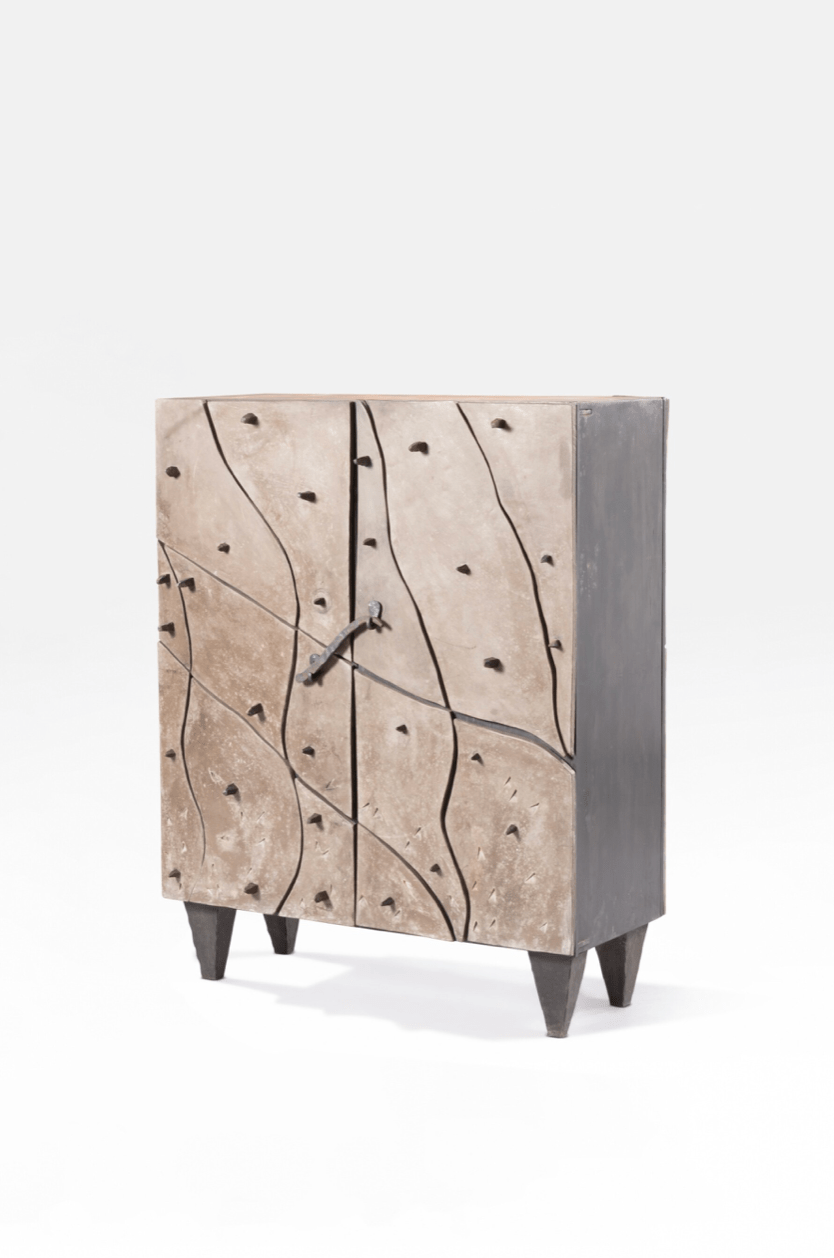
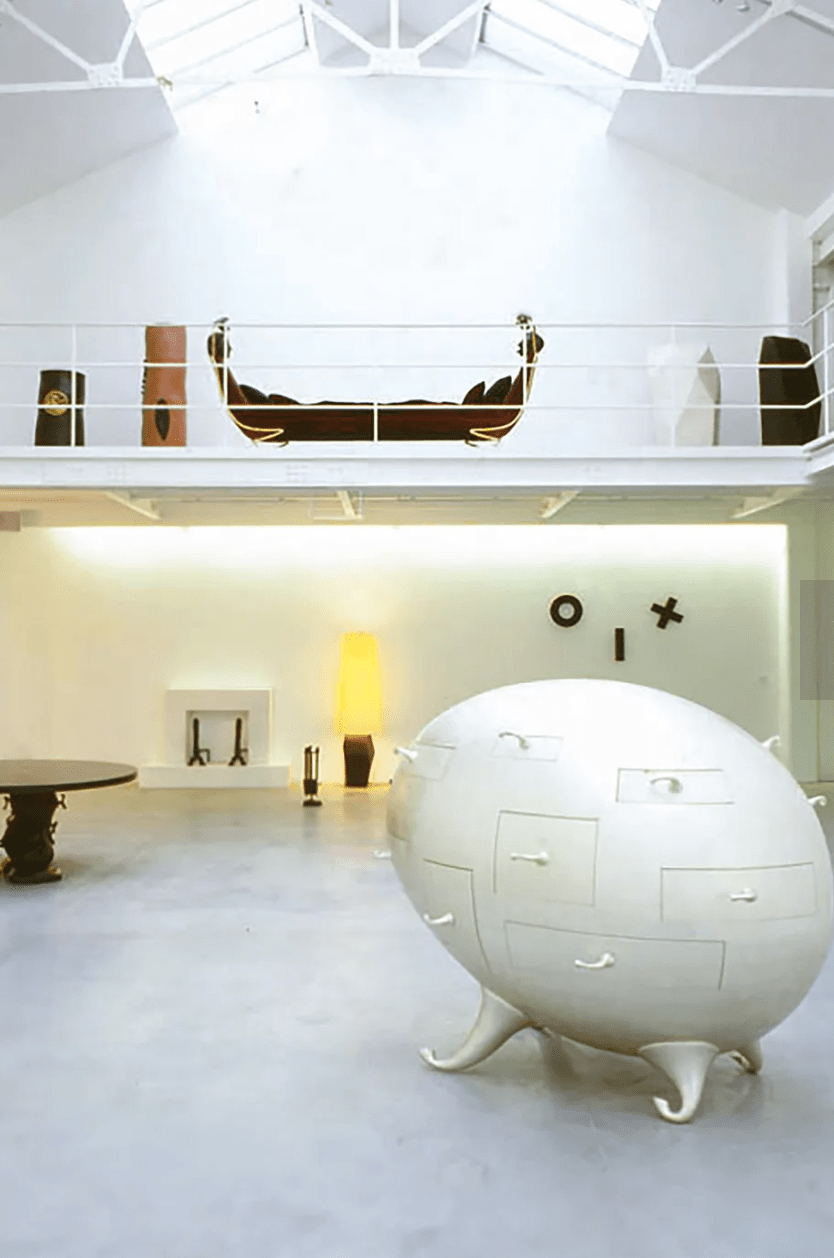
Founded in the same year, Galerie Néotù and En Attendant les Barbares shared a common drive: to free design from modernist conventions. With Pierre Staudenmeyer, furniture became a critical object capable of dialoguing with contemporary thought; with Agnès Kentish, it was imbued with imagination and dream. In the 1990s, BGH Éditions carried this spirit forward by producing limited editions of Garouste & Bonetti’s works. Their Masque Lamp (around 1991), in patinated bronze, illustrated their poetic approach to furniture — somewhere between ritual object and symbolic sculpture. Meanwhile, London’s David Gill Gallery pursued another direction, oriented toward the international collectible design market, while Avant-Scène perpetuated the tradition of great French decorators. Yet at heart, Néotù and En Attendant les Barbares shared the same intuition: that design could be at once emotion, narrative, and experience.
Named Designers of the Year in 1991, Élizabeth Garouste and Mattia Bonetti became emblematic of an era when design became expression. Their works are now held in the Centre Pompidou, the Musée des Arts Décoratifs in Paris, and major international collections. As Pierre Staudenmeyer once summarized: “If form must result from rational requirements, it must therefore convey a story and an emotion.”
This conviction, shared by Néotù and En Attendant les Barbares, perfectly encapsulates the spirit of French postmodern design: a humanist, expressive design full of stories.
Garouste & Bonetti: the theatre of the publishers
At the turn of the 1980s, design began to move away from the modernist and functional ideals inherited from the Bauhaus, exploring new expressive directions. After the industrial utopias of the 1970s, a new generation of creators sought a design that was more emotional, narrative, and culturally hybrid. They combined historical references, craftsmanship, and formal experimentation to restore a symbolic and emotional dimension to objects. Among them, Élizabeth Garouste and Mattia Bonetti embodied this new sensibility. Their creations, halfway between furniture and sculpture, embraced fantasy, color, and ornament as a form of resistance to the prevailing minimalism.
It was in this context that Pierre Staudenmeyer and Gérard Dalmon founded the gallery-publisher Néotù in Paris in 1984. For Staudenmeyer, design was a territory of thought: furniture became a medium for artistic and emotional reflection. Néotù quickly established itself as a true laboratory of expression and creation. It was a place to exhibit, publish, and theorize, each presentation conceived as an intellectual proposition — a dialogue between artists, artisans, and ideas. Facing Galerie Avant-Scène, heir to the great French decorative tradition, or London’s David Gill Gallery, a showcase for international collectible design, Néotù asserted a different vision of French postmodern design. Around the same time in Paris, another editorial gallery emerged: En Attendant les Barbares, founded by Agnès Kentish.
Through this approach, Élizabeth Garouste and Mattia Bonetti opposed the sanitized, monochrome world of contemporary creation, then dominated by the black-and-white radical chic aesthetic and the industrial production inherited from the CCI (Centre de Création Industrielle). Their work resembled a true reinvention of the decorative arts, liberated from theoretical dogmas and the tyranny of “good taste.”
Their Barbare Chair (1981), made of animal hide stretched over a patinated metal frame with a bronze-like finish, condensed this imaginary world between primitive fable and dream archaeology. For them, “in exoticism, there is always something unknown that fascinates us. A showcase full of objects a child cannot touch, an attic — that’s already exoticism.”
Each piece seemed to emerge from an Aladdin’s cave, a Noah’s Ark, or a cabinet of curiosities, where humor met poetry and craftsmanship. With the support of Néotù, and later En Attendant les Barbares, Garouste & Bonetti found a space suited to them: a place where matter thinks, and form tells a story. These galleries became true stages, in the literal sense — a theatre of furniture.
While Néotù explored design as a conceptual language, En Attendant les Barbares embodied it as pure emotion. Both galleries shared the same ambition: to blur the boundaries between art, design, and craft, in order to restore to the object a living presence and meaningful depth.
Within this fertile landscape, the V.I.A. (Valorisation de l’Innovation dans l’Ameublement), created by the French furniture industry, also played an important role. A true springboard for young designers, it encouraged experimentation and supported a new generation of creators. Its exhibitions quickly revealed major figures such as Martin Szekely, Philippe Starck, Jean-Michel Wilmotte, Élizabeth Garouste & Mattia Bonetti, and Gaetano Pesce, who would shape the following decades.
At the heart of this creative effervescence, one duo stood out: Élizabeth Garouste and Mattia Bonetti. Their meeting in the late 1970s gave birth to a baroque, theatrical, and free-spirited universe where poetry mingled with experimentation. Often described as the “new barbarians” of French design, they invented a singular language that erased the line between décor and the decorative. Their creations — chairs covered in cowhide or pony skin, bronze tables, wrought-iron mirrors, patinated bronze lamps (such as the Lune Lamp, 1984), or colorful wicker pieces — seemed to come straight out of a strange fairy tale. These expressive, symbolic furniture-sculptures embodied a constant desire to create wonder, to reconnect with the childhood sense of exoticism where the unknown both fascinates and inspires.
Lire les autres focus
