

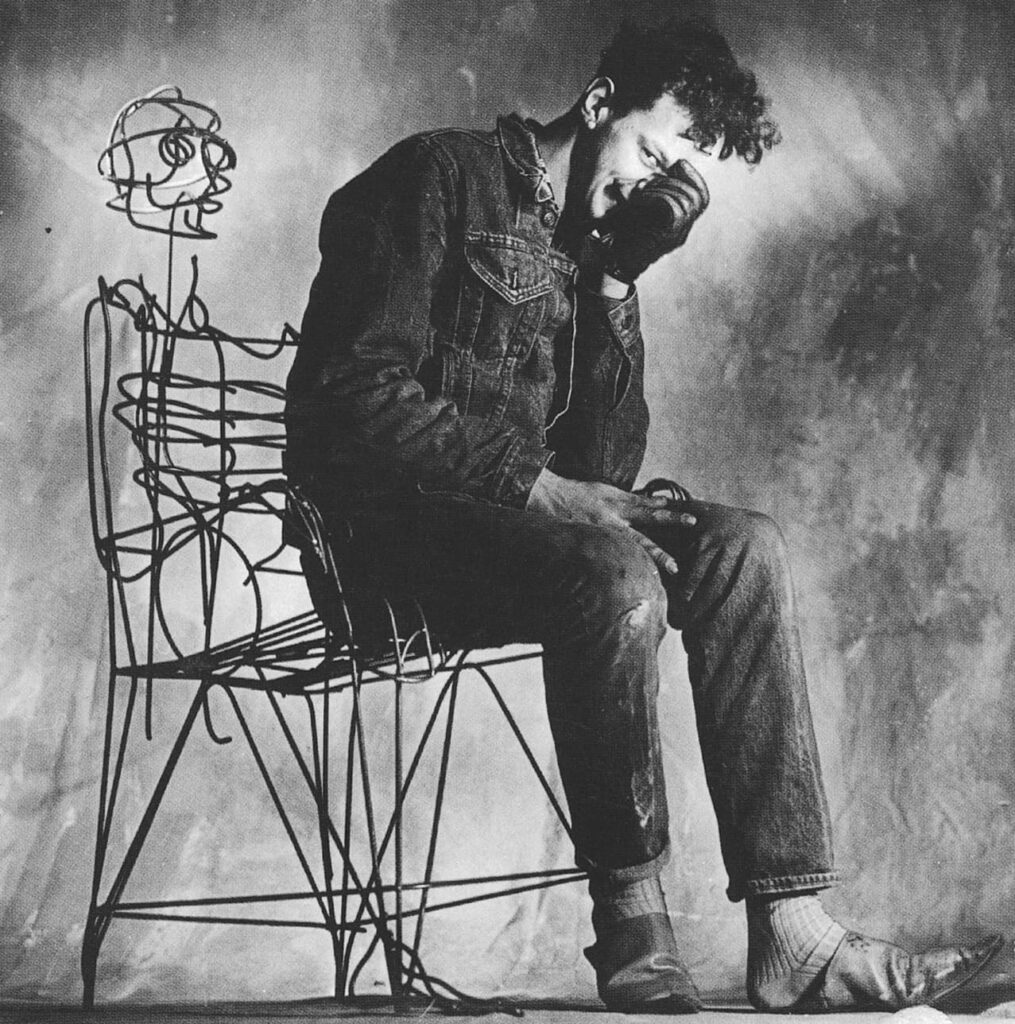
Tom
Dixon
SELF-TAUGHT, TOM DIXON MOVES AWAY FROM CONVENTIONAL PATHS AND BUILDS HIS WORK FROM SALVAGED MATERIALS.
Born in Tunisia to a British father, an English teacher, and a mother who worked as a journalist for the BBC World Service, Tom Dixon grew up between several cultures before settling in London. A student at Holland Park Comprehensive School in the early 1970s, he discovered pottery and drawing, two practices that introduced him early on to proportion and balance, a decisive influence on his later work.
After a brief period at Chelsea College of Art and Design, which he left following a motorcycle accident, his path took an unexpected turn. In the early 1980s, he became a professional musician and played bass in the band Funkapolitan. He later worked as a painter for an animation company, before another road accident once again interrupted his activity.
It was during this period, marked by detours and experimentation, that he discovered welding as a revelation. Using salvaged metal objects, he began creating his first pieces, transforming industrial fragments into furniture with free-form shapes. This practice quickly became central to his work. The gesture is direct, the joints remain visible, and the object fully embraces its method of making.
His early creations met with a certain success, and his workshop soon brought together around twenty people working with metal, including Thomas Heatherwick and Michael Young. He also co-founded the Creative Salvage collective with André Dubreuil and Mark Brazier-Jones, exploring recycling and the repurposing of industrial materials.
Over the years, his work evolved. Without abandoning this raw approach, the forms became more defined and gained in balance, while retaining a certain freedom.
Appointed artistic director of Habitat in 1995, he expanded his field of activity before founding his own publishing company in 2002. His unconventional and uncompromising path reflects a constant evolution, from experimental work toward more assertive forms, always guided by material and a desire to invent.
