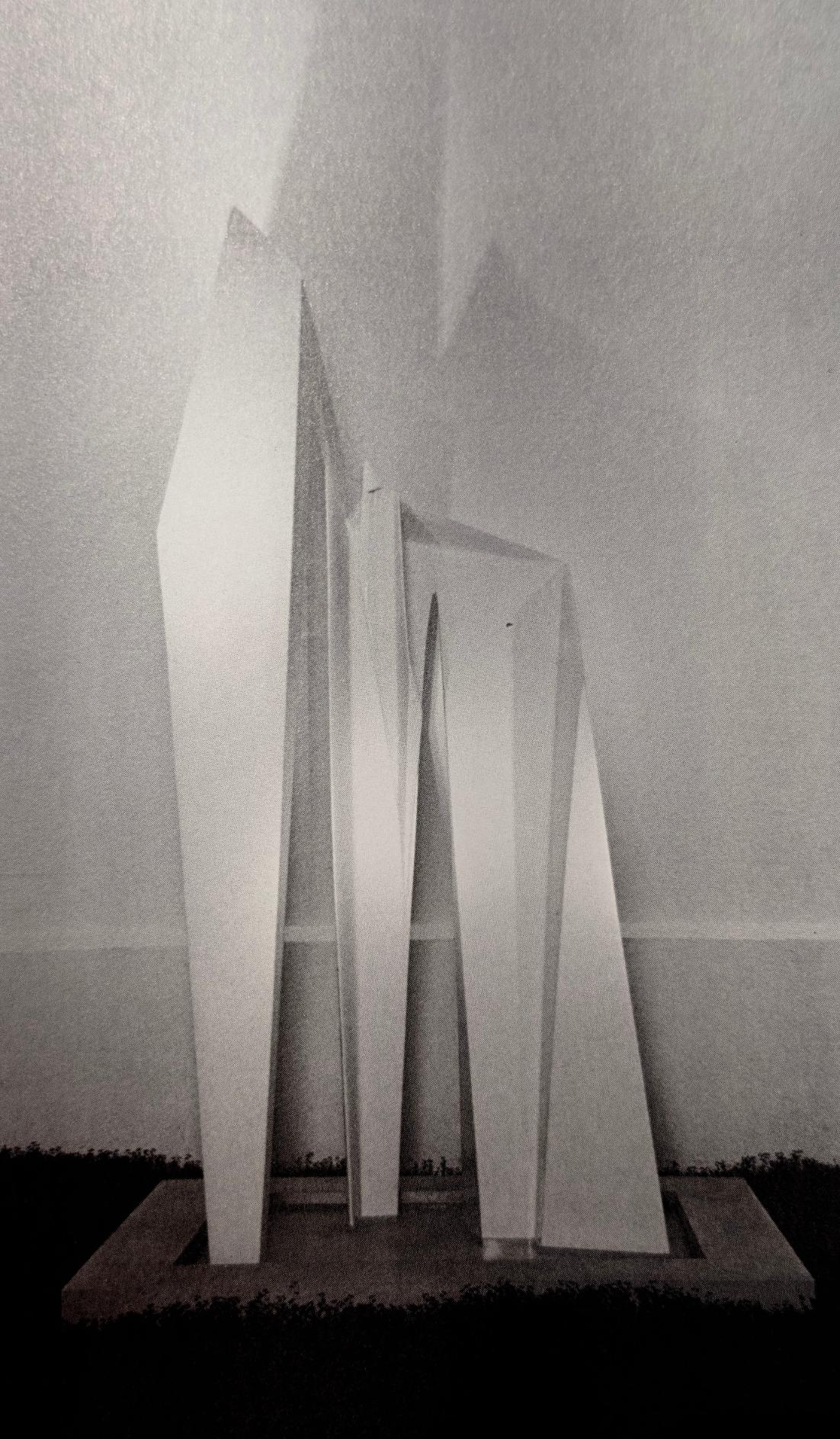
Whether stone, metal, or resin, material in Yves de La Tour d’Auvergne’s hands is never neutral. His experimental approach aligns him with the lineage of modern sculptors – from Picasso to César and Arman – who expanded the scope of sculpture beyond its traditional materials.
In the Lampadaire Totem (1984), made of marble powder and metal, material becomes a true vessel for light. The use of crushed marble, folded like origami, allows the surface to capture and diffuse light rather than reflect it.
In his work, patina plays a central role. A charcoal gray, applied in subtle layers, gives the surface a sheen reminiscent of bronze while preserving the fineness of the material. This signature tone appears in several of his patinated metal pieces, such as the Gradiva bench (1984) and the Amaryllis seat (1983), where the surface reflects light with quiet restraint. Through this treatment, Yves de La Tour d’Auvergne pursued a constant balance in the sculptural effect of his pieces, paying particular attention to how each one anchors itself within an interior and converses with its surroundings.
Most of his works were produced in editions of eight numbered pieces, following the tradition of bronze sculpture, where such limitation guarantees the status of an original work. Not all of his creations strictly adhere to this rule, yet the spirit remains. Even in commissioned projects, Yves de La Tour d’Auvergne approached each piece with the same exacting standards as a sculpture. The respect for form, patina, light, and spatial relation elevates these objects to the status of artworks rather than mere furnishings.

His 1980s production reflects this desire to merge sculpture and function. The Demi-Lune stool-table (1984) and the Christony sofa (1987) embody his pursuit of balance between form and utility. Griotte (1991), a bronze and marble-powder table, continues this exploration: its striking, almost architectural shape gives the piece a dynamic, almost kinetic presence.
In the late 1990s, he created a series of human silhouettes in marble powder – purified, monumental forms, some rising over 3.6 meters high. These figures extend his exploration of light and spatial volume. As Pierre Daix observed, “By creating couples, he plays with the encounters between the supple inflections of his surfaces – their grazes, their caresses, their intertwinings until they touch – as well as with the voids between them, producing an inner vitality that brings movement to the whole.” This dialogue between fullness and emptiness is heightened by openwork effects that allow light to pass through the sculpture.
The entire body of Yves de La Tour d’Auvergne’s work rests on one conviction: sculpture must converse with light and void. By integrating function – lamp, seat, table – he does not seek to soften the rigor of sculpture, but to confront it with use, to test form within the framework of daily life. In doing so, he continues the great modernist tradition of sculptural design, while infusing it with a poetic, almost meditative dimension. Between sculpture and design, he created a territory where matter breathes, light becomes almost tangible, and every fold, shadow, and patina becomes a sensory experience. For him, the functional is never purely utilitarian – it extends the sculptor’s gesture, maintaining a constant dialogue between form, space, and light.
Yves de La Tour d’Auvergne, Sculptor Before Designer
A sculptor above all, Yves de La Tour d’Auvergne extended his creative vision into the realm of design, infusing it with the same plastic rigor. Born in 1927, he belongs to that generation of artists for whom sculpture was no longer a mere extension of painting, but an autonomous space where light itself becomes material. After establishing himself in the 1970s with monumental sculptures, he went on to explore, over the following decades, a more intimate territory: furniture conceived as a natural continuation of sculptural form.
Before dedicating himself fully to sculpture, Yves de La Tour d’Auvergne was a painter. Trained in the discipline of pictorial composition, he sought early on to transcend the limits of the canvas. His paintings, structured by strong geometric axes and dominated by white, gradually came to feel too enclosed to allow light to circulate freely. “I always found something artificial in the painting (…). I felt frustrated,” he once explained, revealing his need to move toward sculpture to work more directly with light.

His 1980s production reflects this desire to merge sculpture and function. The Demi-Lune stool-table (1984) and the Christony sofa (1987) embody his pursuit of balance between form and utility. Griotte (1991), a bronze and marble-powder table, continues this exploration: its striking, almost architectural shape gives the piece a dynamic, almost kinetic presence.
In the late 1990s, he created a series of human silhouettes in marble powder – purified, monumental forms, some rising over 3.6 meters high. These figures extend his exploration of light and spatial volume. As Pierre Daix observed, “By creating couples, he plays with the encounters between the supple inflections of his surfaces – their grazes, their caresses, their intertwinings until they touch – as well as with the voids between them, producing an inner vitality that brings movement to the whole.” This dialogue between fullness and emptiness is heightened by openwork effects that allow light to pass through the sculpture.
The entire body of Yves de La Tour d’Auvergne’s work rests on one conviction: sculpture must converse with light and void. By integrating function – lamp, seat, table – he does not seek to soften the rigor of sculpture, but to confront it with use, to test form within the framework of daily life. In doing so, he continues the great modernist tradition of sculptural design, while infusing it with a poetic, almost meditative dimension. Between sculpture and design, he created a territory where matter breathes, light becomes almost tangible, and every fold, shadow, and patina becomes a sensory experience. For him, the functional is never purely utilitarian – it extends the sculptor’s gesture, maintaining a constant dialogue between form, space, and light.
Lire les autres focus