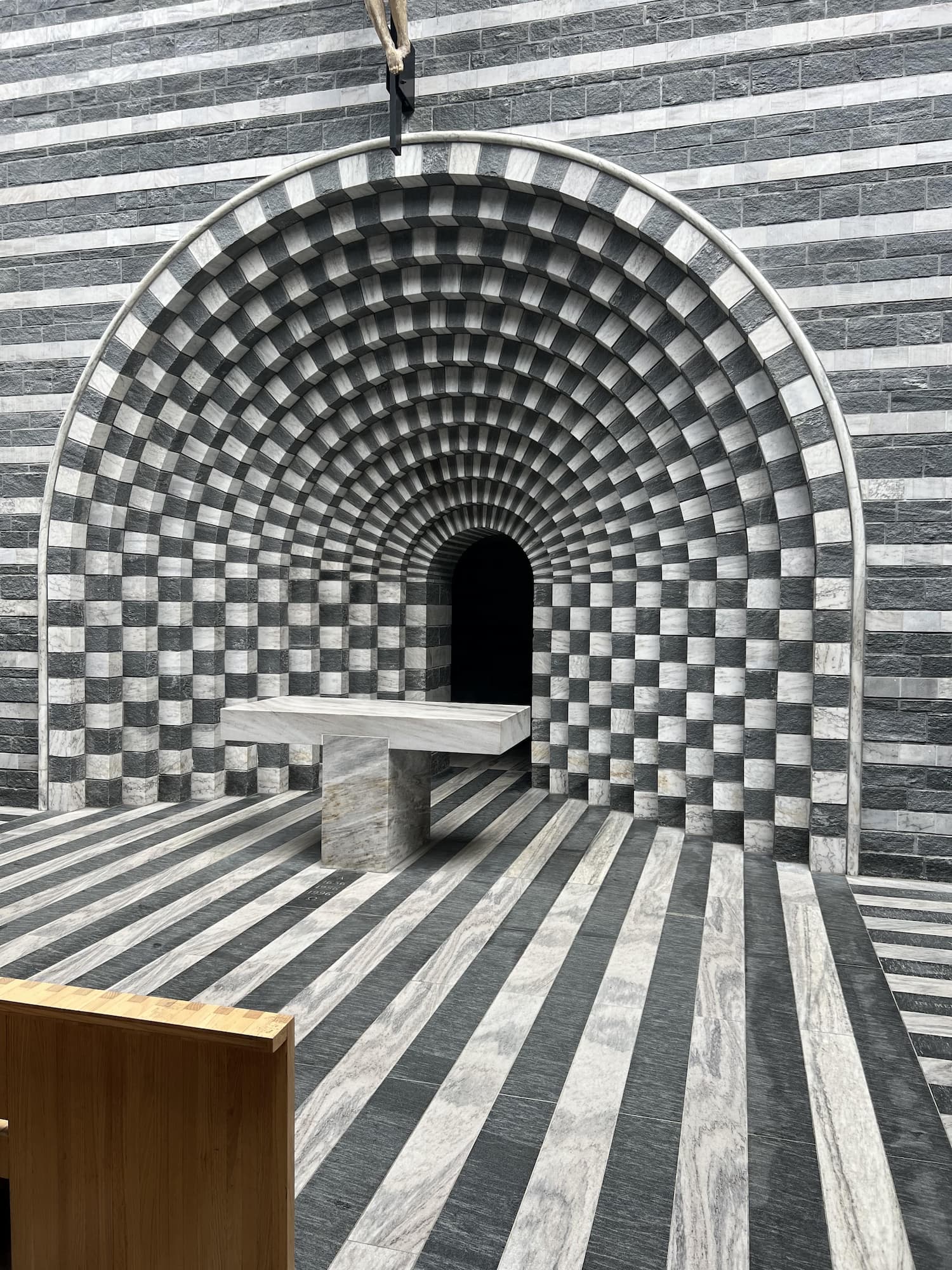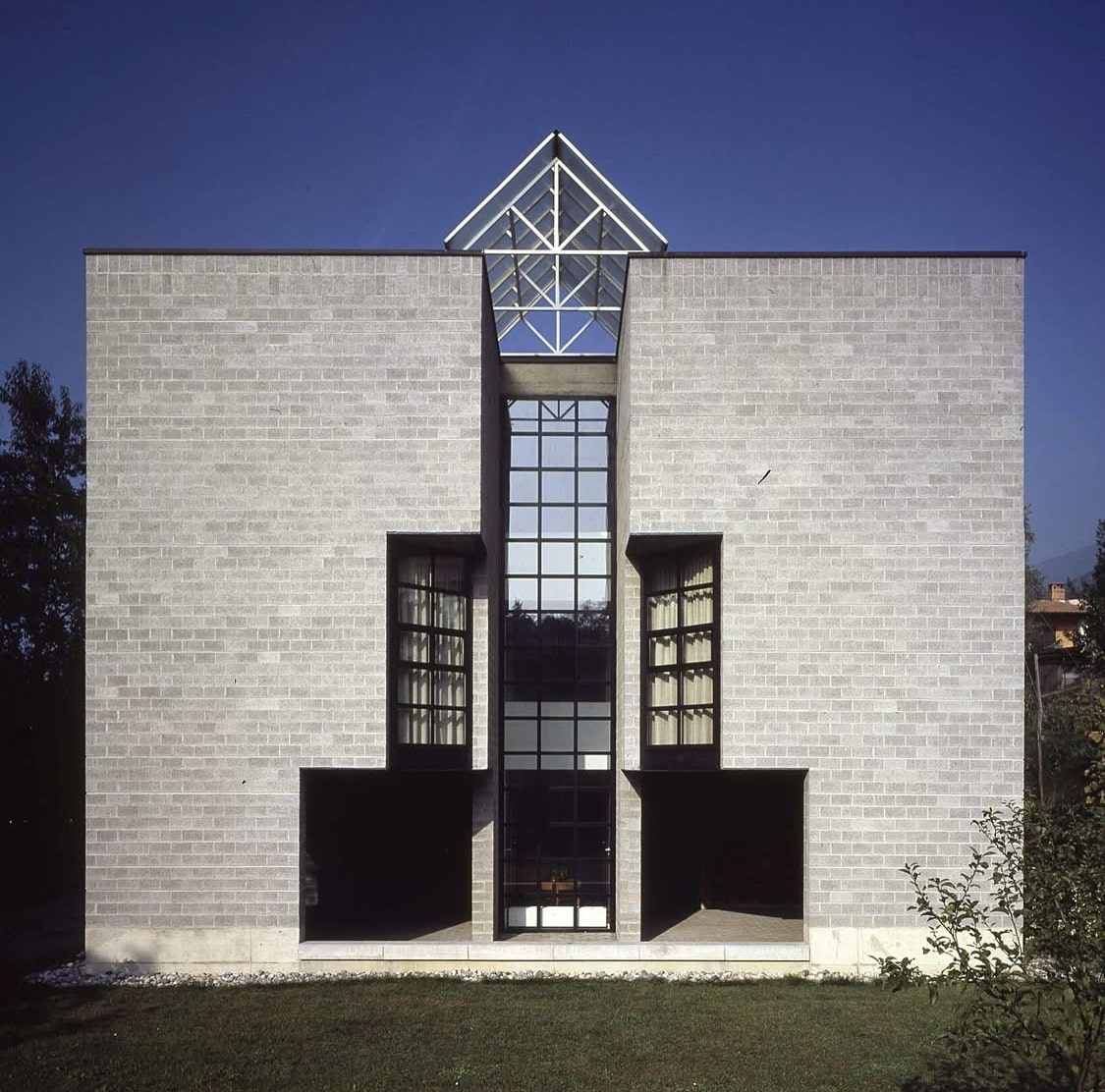
In contrast to the “postmodern chatter,” Mario Botta’s architecture asserts itself through its autonomy. It is rooted in the Ticino landscape, in a constructive tradition of bricks, stone, and masonry, and transcends it into universal forms. Squares, circles, cylinders, and cubes come together with a sober monumentality, attentive to light and multiplied perspectives. “With Botta, material and form always make a good synthesis,” critics already wrote about the intersecting arches of Vacallo.
This clarity of vision was recognized internationally in 1986–87, when the MoMA in New York devoted a monographic retrospective to him, inscribing his work in the lineage of Le Corbusier and Louis Kahn. Yet Mario Botta resists mere filiation: he pursues a personal path, nourished as much by history as by an almost fatalistic relationship with creation. “In architecture, I also love those aspects that words cannot capture,” he confides.
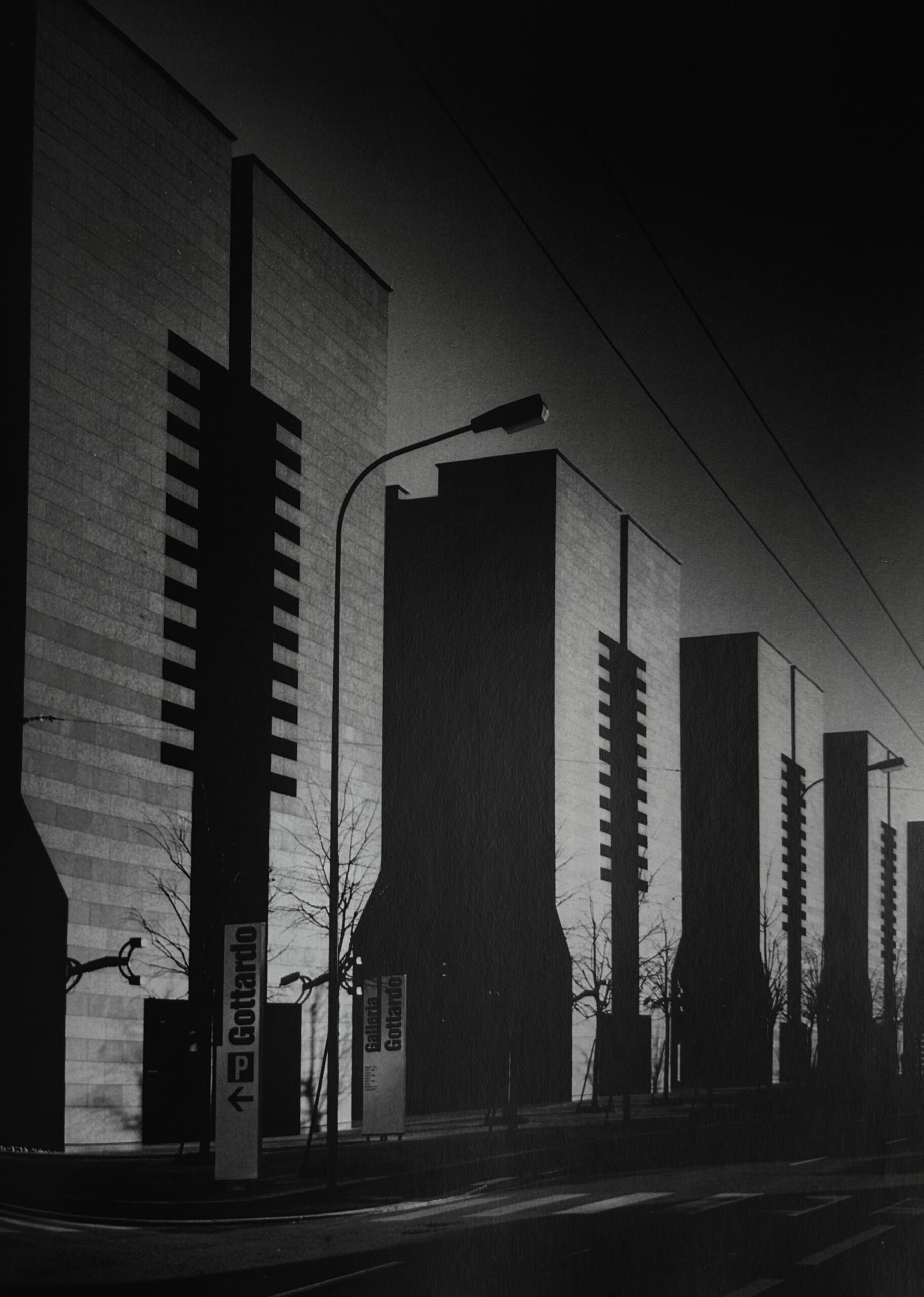
From the 1980s onwards, Mario Botta took on the scale of public buildings banks, schools, museums infusing them with the same architectural intensity as his houses.
The Gotthard Bank (1982–1988) in Lugano perfectly illustrates Botta’s ability to transpose the characteristics of his domestic architecture to the monumental scale of institutions. Each project, whether an administrative building in Fribourg or an experimental house in Pregassona, extends his exploration of elementary geometric forms and of spatial organization that feels clear, almost inevitable.
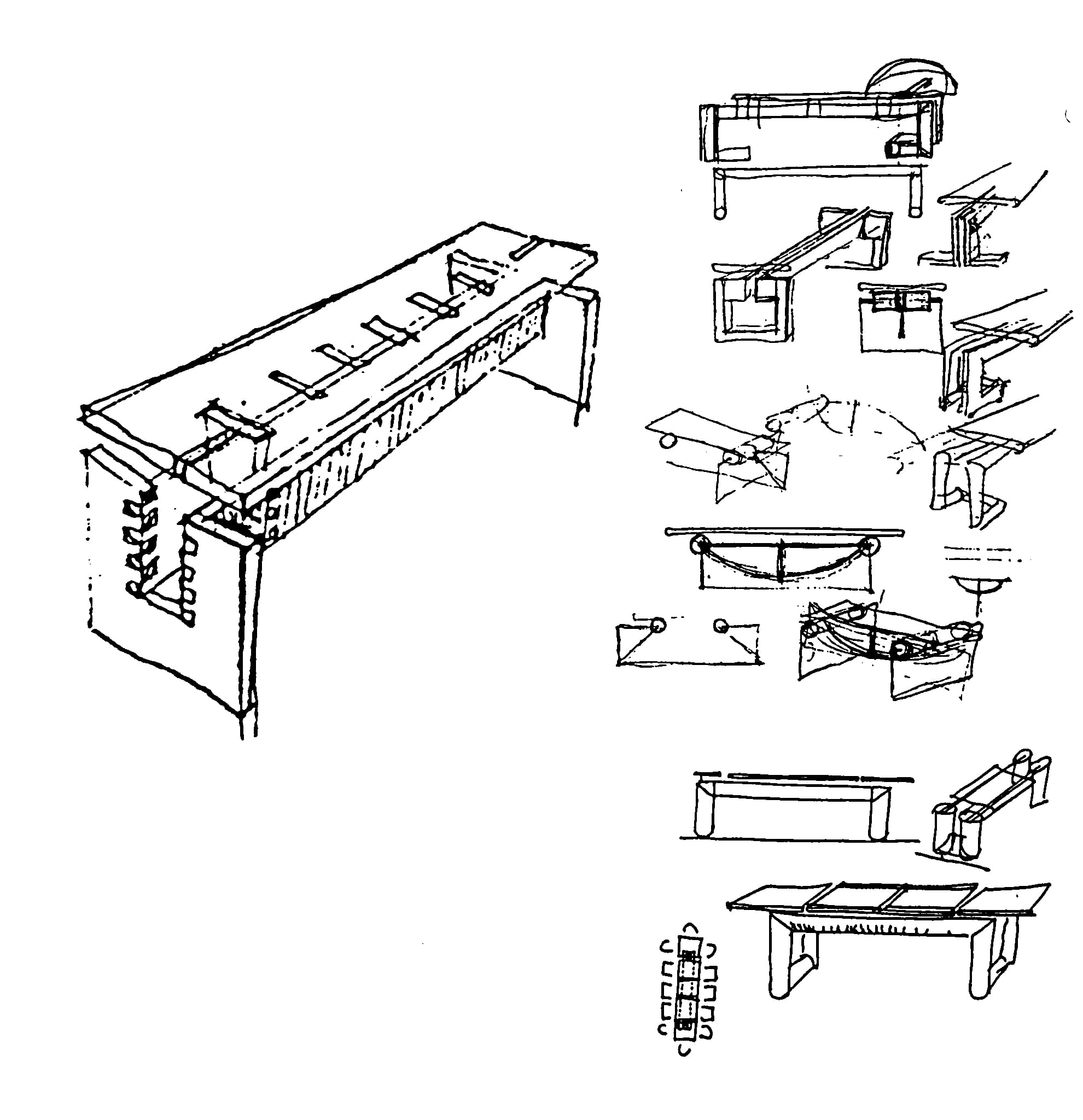
It is in this context that his interest in design emerged. The transition occurred naturally, without rupture: “Yes,” he says, “I am interested in the chair as I am in the city. What attracts me is the intensity of things, not their size or their theme.” Whether architecture or design, Mario Botta conceives with the same gesture. The sketches for the Terzo table are a striking example: they reveal both the frontal module of the Gotthard Bank and the inverted T motif, an architectural symbol and formal signature.
In his furniture as in his buildings, Botta summons the same language: elementary geometries, crisp structures, decorations made of parallel or V-shaped bands. These motifs draw on a long Ticino tradition, which he transposes with equal intensity into a chair or a church. “Whether in architecture or design, there is no break between conception and drawing,” he asserts. One may cite, for example, the Sesta Re e Regina sofa, whose backrest reprises a V-shaped motif also found in the walls of the Mogno church and in the wide opening of the house in Massagno.
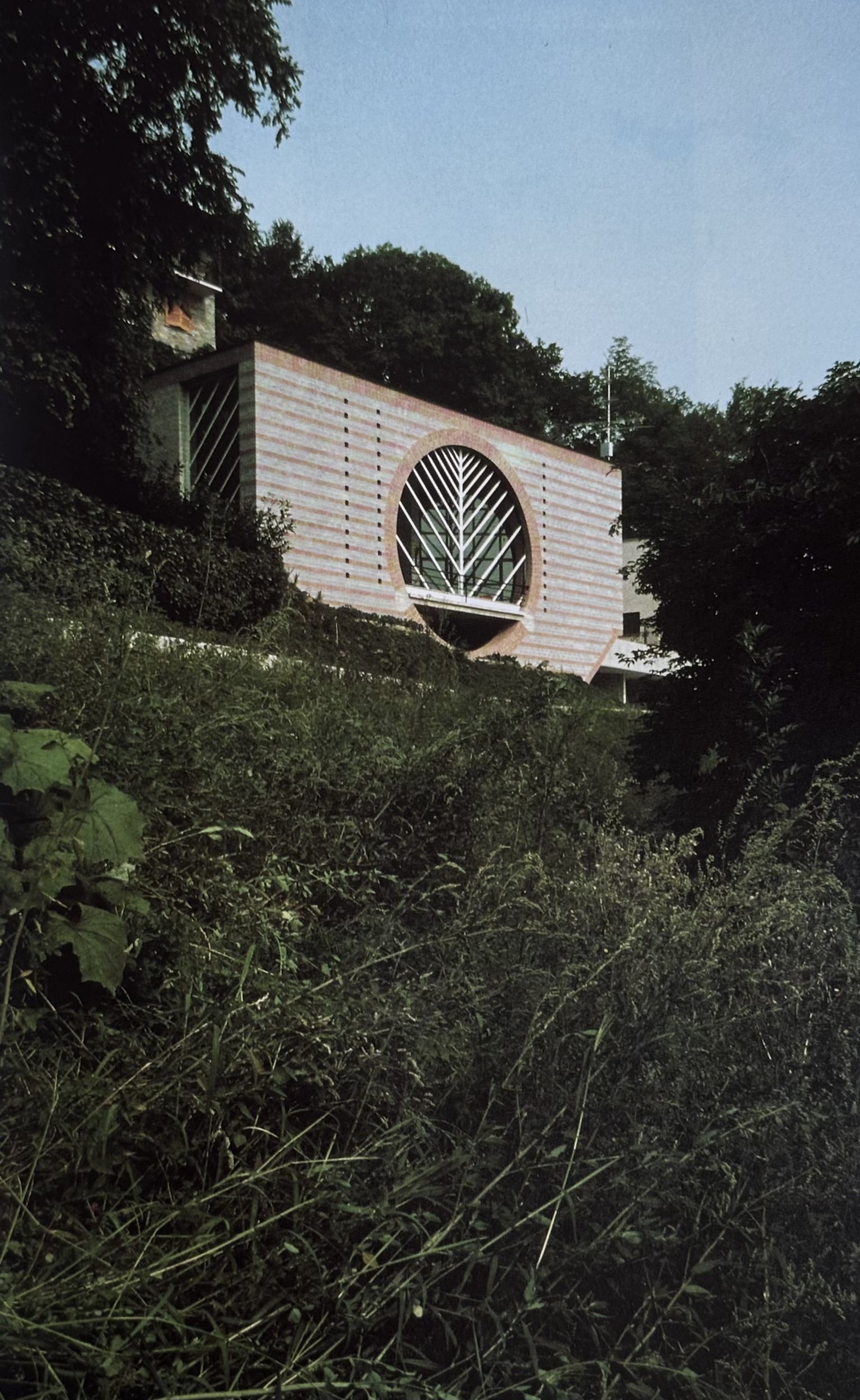
Mario Botta thus belongs to the rare lineage of twentieth-century architect-designers, alongside Charles Rennie Mackintosh, Marcel Breuer, or Ludwig Mies van der Rohe. While he acknowledges the legacy of Louis Kahn, Carlo Scarpa, and Le Corbusier, he also establishes himself as a classic already inscribed in history, whose work combines permanence and invention.
With Mario Botta, everything is a matter of evidence: a higher need for space governs his drawings, a clarity of thought sustains his creative process, geometric rigor meets materiality. His works are not mere constructions or mere objects: they are fragments of a total language, one that brings architecture and design, past and present, territory and universality into dialogue.
Botta, architect before designer
If the name Mario Botta immediately calls to mind his furniture and cylindrical foam seats, it would nonetheless be reductive to confine his work to a single scale. Before turning to furniture and objects, Botta was and remains an architect. An indefatigable creator whose works are silent manifestos that render words superfluous.
Born in 1943 in Mendrisio, in the Swiss Ticino, Mario Botta studied in Venice under Carlo Scarpa and very early developed a sensibility that combined geometric rigor with emotional intensity. His first houses, such as those in Riva San Vitale (1971) and Ligornetto (1976), were enough to secure him a place in the history of contemporary architecture. Remarkably mature for an architect barely in his thirties, these works escape fashion to impose themselves as timeless certainties.
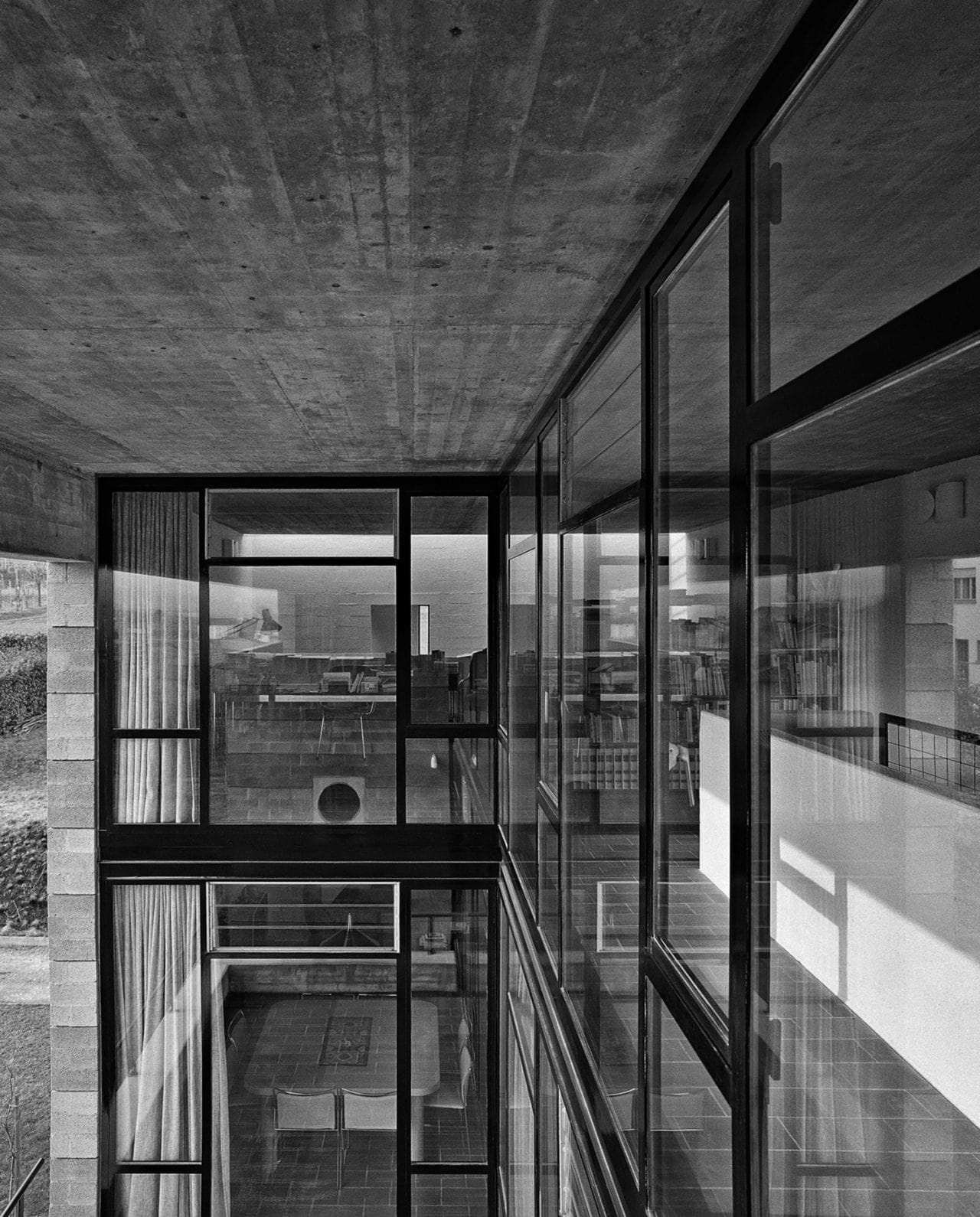
From the 1980s onwards, Mario Botta took on the scale of public buildings banks, schools, museums infusing them with the same architectural intensity as his houses.
The Gotthard Bank (1982–1988) in Lugano perfectly illustrates Botta’s ability to transpose the characteristics of his domestic architecture to the monumental scale of institutions. Each project, whether an administrative building in Fribourg or an experimental house in Pregassona, extends his exploration of elementary geometric forms and of spatial organization that feels clear, almost inevitable.
It is in this context that his interest in design emerged. The transition occurred naturally, without rupture: “Yes,” he says, “I am interested in the chair as I am in the city. What attracts me is the intensity of things, not their size or their theme.” Whether architecture or design, Mario Botta conceives with the same gesture. The sketches for the Terzo table are a striking example: they reveal both the frontal module of the Gotthard Bank and the inverted T motif, an architectural symbol and formal signature.
In his furniture as in his buildings, Botta summons the same language: elementary geometries, crisp structures, decorations made of parallel or V-shaped bands. These motifs draw on a long Ticino tradition, which he transposes with equal intensity into a chair or a church. “Whether in architecture or design, there is no break between conception and drawing,” he asserts. One may cite, for example, the Sesta Re e Regina sofa, whose backrest reprises a V-shaped motif also found in the walls of the Mogno church and in the wide opening of the house in Massagno.
Lire les autres focus