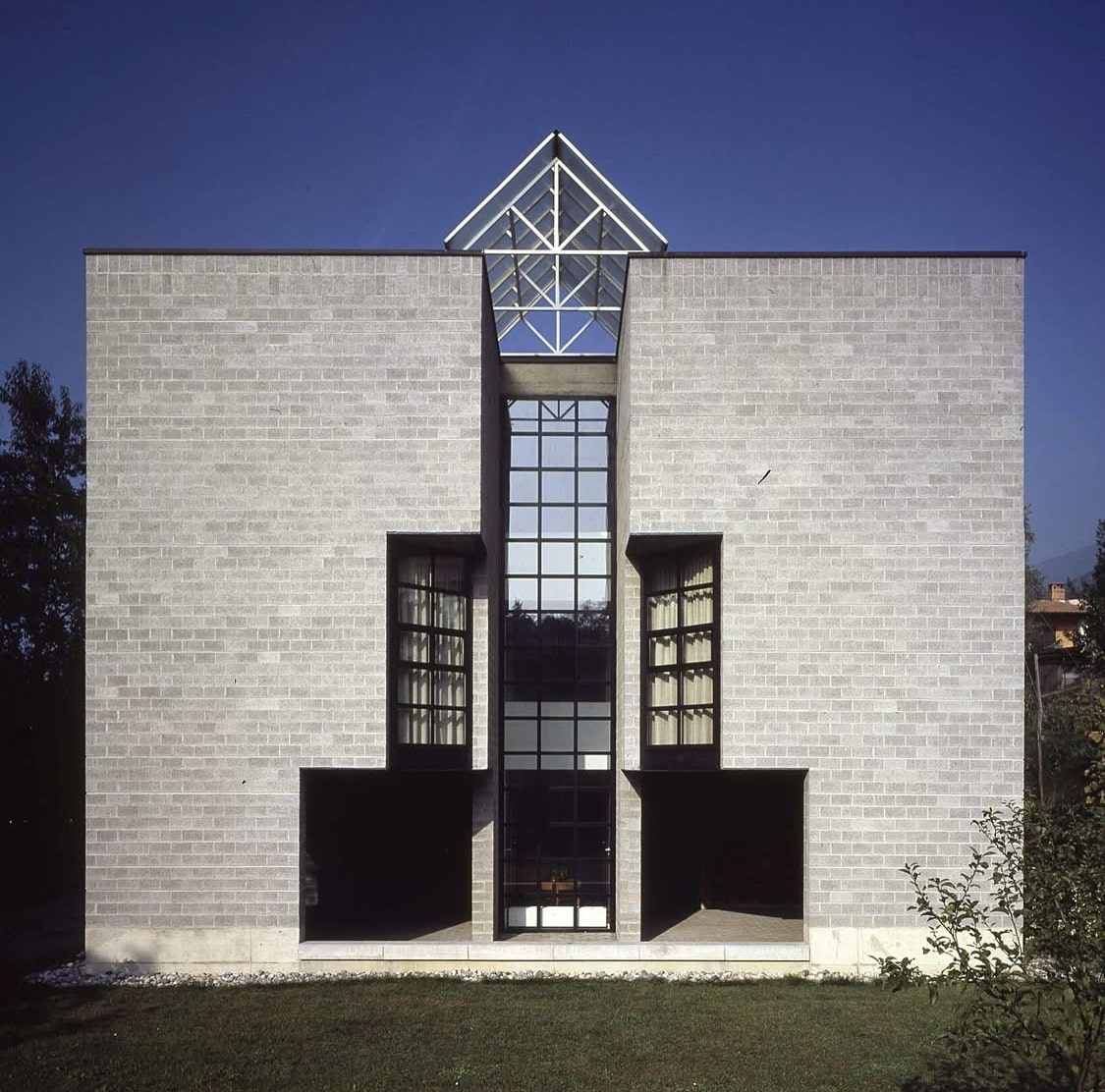
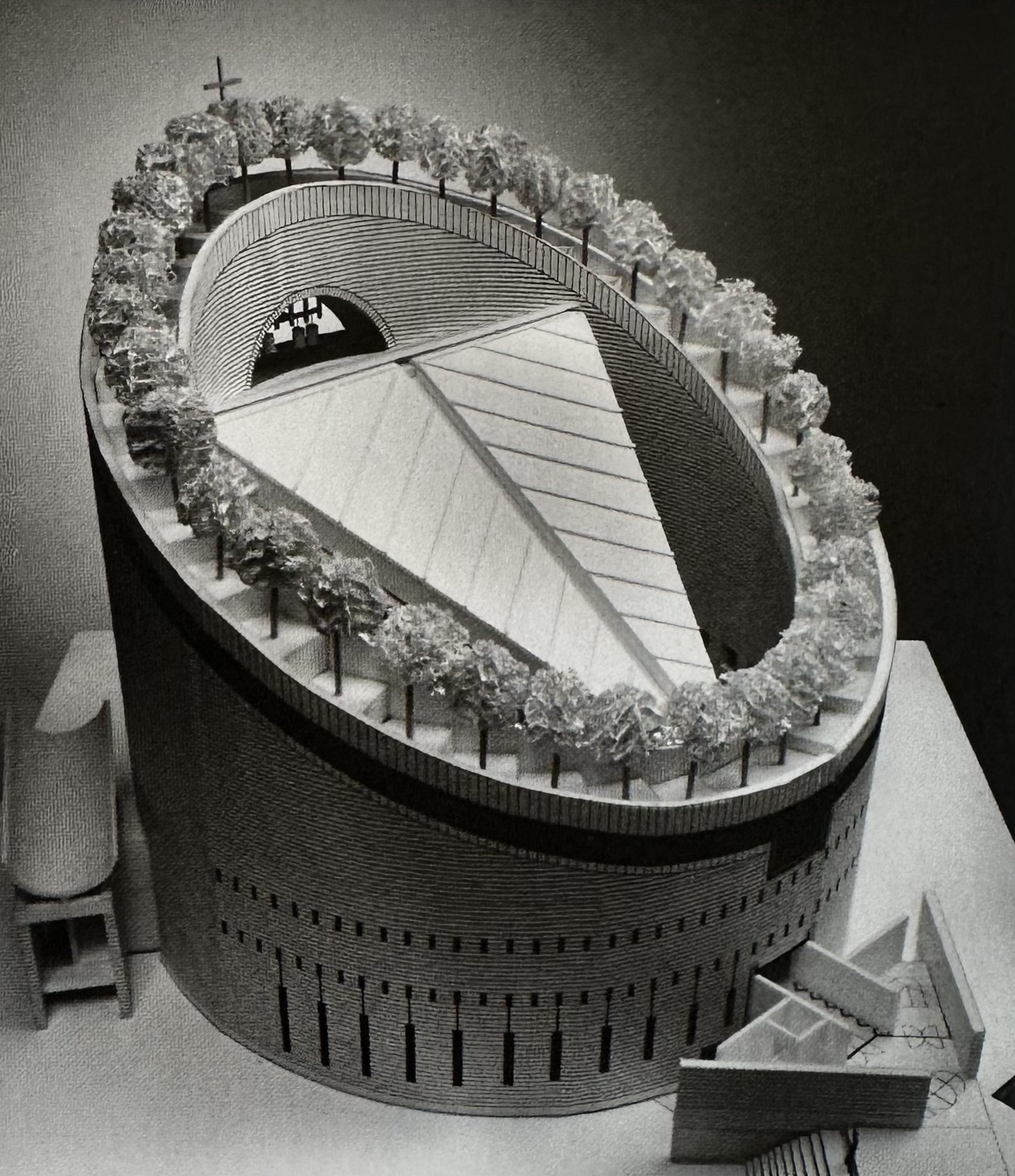
At the end of the 1980s, Mario Botta was entrusted with the design of the Cathedral of Évry, the last cathedral built in France in the 20th century. He conceived a circular volume in Toulouse brick, resting on two interlocking reinforced concrete cylinders. The choice of brick is no accident: as a material of memory and rootedness, it symbolically connects the inhabitants to the land and to History.
The cylinder opens towards the sky through an inclined top, crowned with trees. A true “hanging garden,” it resonates like a Garden of Eden hovering above the cathedral. It redefines the very idea of a façade and powerfully emphasizes the silhouette of the building.
Inside, light gently descends through large upper openings, shifting with the seasons and evoking the passage of time. The space invites a silent pause, open to both believers and those seeking reflection. This project reveals Mario Botta’s interest in urbanism and his determination to anchor each construction within a continuity with the surrounding town or village, without erasing or altering traces of the past.
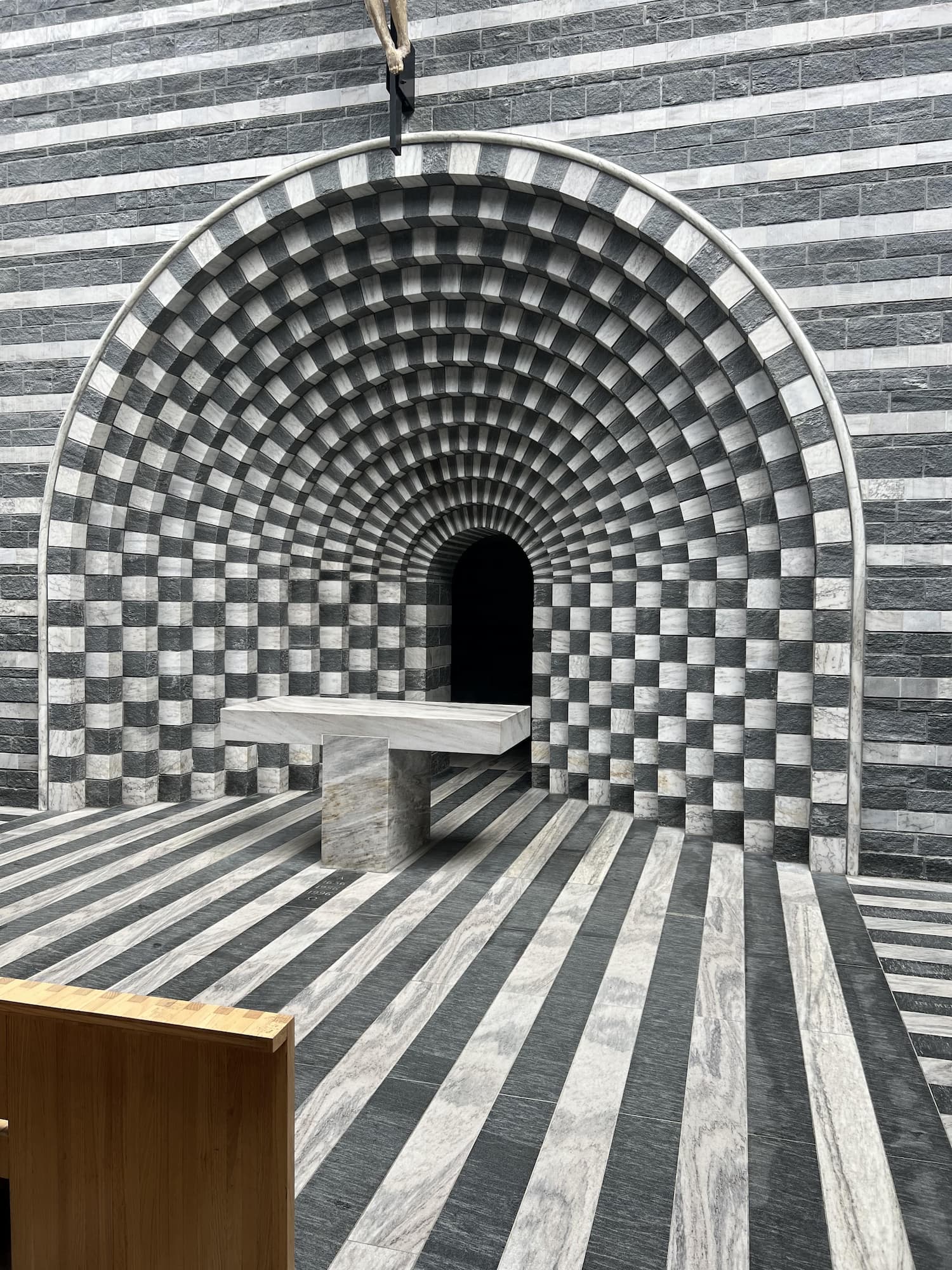
A few years later, Mario Botta rebuilt the Church of San Giovanni Battista in Mogno, a small village lost in the mountains of Ticino, Switzerland, after its destruction by an avalanche. Inaugurated in 1996, the building surprises with its radical modernity. It is defined by the graphic alternation of light marble and dark granite, by windowless walls, and by light filtering only through the glass roof. This interplay of black and white evokes snow resting on rock. The granite, with its almost hammered roughness, contrasts with the smoothness of the light marble, recalling the Alpine landscape.
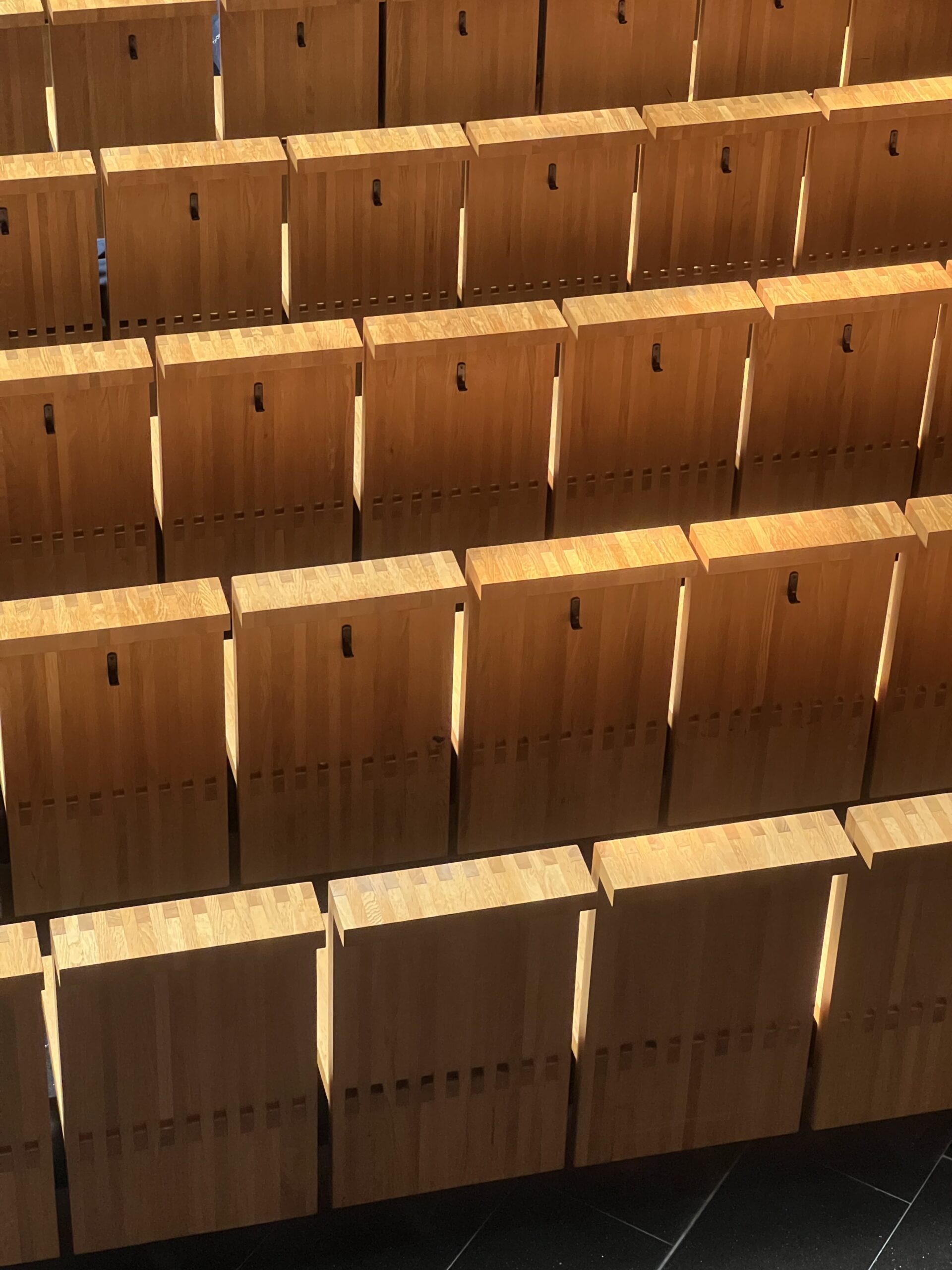
Encountering the Church of San Giovanni Battista for the first time, one is struck by its unexpected, almost disconcerting aspect. Nestled at the end of a winding mountain road, beside a small remote village, it emerges like an architectural object outside of time. Mario Botta never forgets to anchor his work in its context: the entrance door, for example, adopts the same motif as the village houses, establishing a discreet link with traditional architecture. As a final homage to the vanished chapel, relics of the former building were incorporated into the new creation. The old crucifix was adapted to a wall support imagined by the architect, the 17th-century baptismal font was integrated into the forecourt, and the historic Madonna and Child now presides to the left of the altar. Botta did not simply rebuild: he safeguarded the village’s heritage.
The limited space (about fifteen seats) immerses visitors in an intimate, deeply meditative atmosphere.
This monument, designed around the theme of the truncated cylinder, is structured by “V”-shaped lines. This structural motif, animating transparency, reinforces the elegance of the building and recalls the ornamental care that Botta also brings to design. Today, this emblematic achievement extends far beyond the local context and illustrates the way in which he reinvents sacred architecture.
Another striking example of Mario Botta’s architectural creations is the Chapel of Santa Maria degli Angeli, built on Monte Tamaro in Switzerland between 1992 and 1996. This work impresses with its architectural originality. Perched on the edge of a cliff, it is built in porphyry, a magmatic rock, and opens onto an exceptional panorama. Its situation, seemingly in balance on the mountain, gives the place a unique meditative character. Inside, the heart of the church, located beneath a walkway, is enhanced by the pictorial works of Enzo Cucchi.
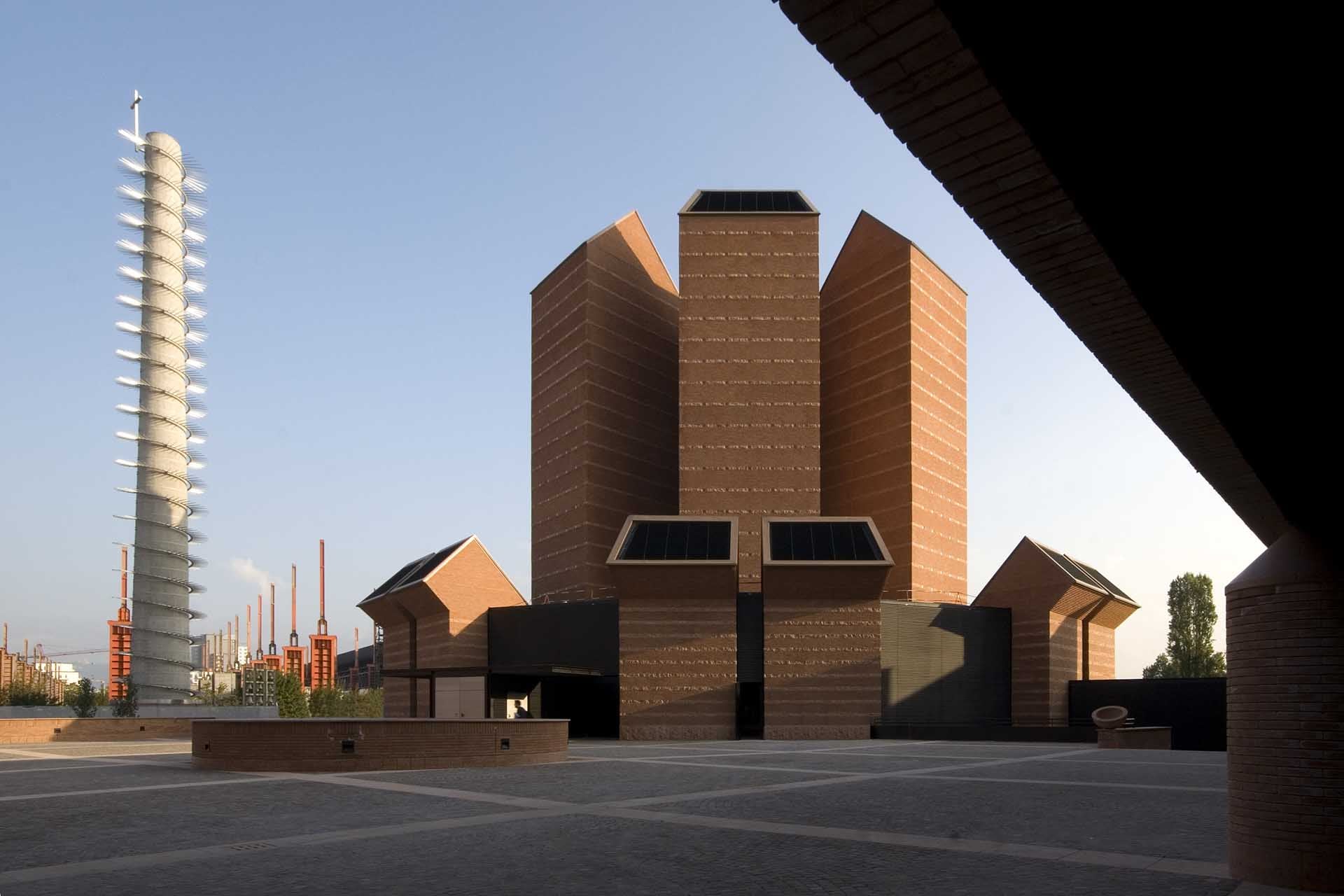
In the same spirit, the Church of Santo Volto in Turin, built between 2004 and 2006, symbolizes the “rebirth” of its neighborhood. For this project, Mario Botta used natural materials: terracotta bricks and Verona red stone for the exterior and the floor, maple wood for the ceilings. The complex covers 12,000 m² and includes two buildings to the northeast, along with the church’s main volume, oriented towards a park. A dome, visible from the inside, completes the central space. Finally, an old brick chimney, a vestige of the site’s industrial past, was preserved and transformed into a bell tower.
Whether in Mogno, Évry, or other church projects across Europe, Mario Botta has always pursued the same ambition: to create places where people can gather and reflect.
For Mario Botta, the religious building is not only a space for faith, but also a place of contemplation in a world of perpetual restlessness.
More broadly, Mario Botta’s churches represent the most accomplished expression of his architecture: an architecture both humble and precise, rooted in its territory yet reaching for the universal.
The Churches of Mario Botta
Born in 1943 in Mendrisio, in Ticino, Mario Botta is one of the leading figures in contemporary architecture. Trained in Venice under Carlo Scarpa, he established himself from the outset with a style that is both rigorous and poetic. His work is characterized by simple geometric forms, the use of raw materials, and a constant reflection on light. Within this vast body of work, his churches hold a unique place: they are not merely places of worship, but true spiritual experiences, accessible to all.
In Botta’s religious buildings, light plays an essential role. Rarely frontal or ostentatious, it slips through discreet openings, filters through roofs, or descends from upper apertures. The alternation and juxtaposition of regional stones provide a chromatic contrast to the whole. Always rooted in his territory, Mario Botta builds without imposing his work. His architecture challenges established conventions and stands apart from centuries-old buildings. With a precision worthy of the great masters of architecture, Botta adapts his creations without distorting their environment. The contemporary blends with the pre-existing, as if the two had always complemented one another in a single, unified place.
Encountering the Church of San Giovanni Battista for the first time, one is struck by its unexpected, almost disconcerting aspect. Nestled at the end of a winding mountain road, beside a small remote village, it emerges like an architectural object outside of time. Mario Botta never forgets to anchor his work in its context: the entrance door, for example, adopts the same motif as the village houses, establishing a discreet link with traditional architecture. As a final homage to the vanished chapel, relics of the former building were incorporated into the new creation. The old crucifix was adapted to a wall support imagined by the architect, the 17th-century baptismal font was integrated into the forecourt, and the historic Madonna and Child now presides to the left of the altar. Botta did not simply rebuild: he safeguarded the village’s heritage.
The limited space (about fifteen seats) immerses visitors in an intimate, deeply meditative atmosphere.
This monument, designed around the theme of the truncated cylinder, is structured by “V”-shaped lines. This structural motif, animating transparency, reinforces the elegance of the building and recalls the ornamental care that Botta also brings to design. Today, this emblematic achievement extends far beyond the local context and illustrates the way in which he reinvents sacred architecture.
Another striking example of Mario Botta’s architectural creations is the Chapel of Santa Maria degli Angeli, built on Monte Tamaro in Switzerland between 1992 and 1996. This work impresses with its architectural originality. Perched on the edge of a cliff, it is built in porphyry, a magmatic rock, and opens onto an exceptional panorama. Its situation, seemingly in balance on the mountain, gives the place a unique meditative character. Inside, the heart of the church, located beneath a walkway, is enhanced by the pictorial works of Enzo Cucchi.
Lire les autres focus