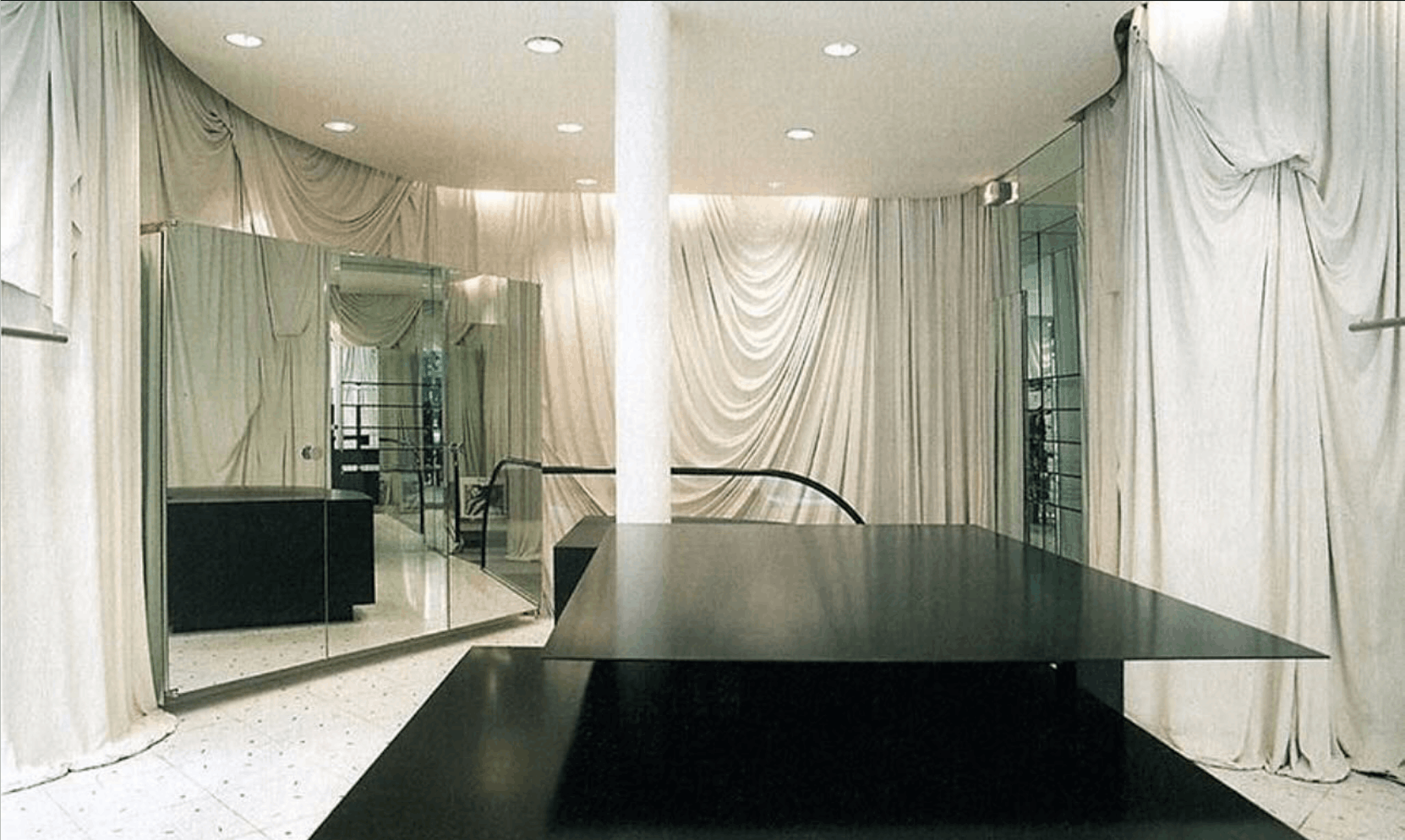
Azzedine Alaïa began collecting furniture pieces by Shiro Kuramata in the early 2000s. This interest took concrete form as early as 2005 with an exhibition the couturier devoted to the Japanese designer. Alaïa brought together around thirty major works, most of them from his personal collection, including the famous How High the Moon sofa (1986), Glass Chair (1976), and Miss Blanche (1988), a transparent acrylic chair containing synthetic roses suspended in resin. These works exemplify Kuramata’s exploration of dematerialization, light, and the unstable perception of form.

This tribute was renewed nearly twenty years later with the exhibition “Alaïa / Kuramata. Lightness in Creation,” presented from June 2024 to February 2025 at the Fondation Azzedine Alaïa. Conceived by Carla Sozzani and Olivier Saillard, this exhibition, which defies the laws of gravity, highlights twenty-two haute couture creations by Azzedine Alaïa and twenty-two works by Shiro Kuramata, all drawn from the foundation’s collections.
The scenography is based on a diptych principle, each piece of furniture entering into direct dialogue with a couture creation. Forms, textures, and movement structure this staging. The metal mesh of a seat thus resonates with the chainmail of certain dresses.

Among the works presented are the Revolving Cabinet, whose modular rigor evokes the influence of Donald Judd; the OBA-Q lamp (1972), the first production by Ishimaru Co. Ltd.; the Ephemera (1989), single-stem vases topped with roses; as well as the Twilight Time and Sing Sing Sing seats (1985). Meticulously articulated, the exhibition succeeds in suspending the ephemeral nature of fashion and design while revealing the visionary dimension of both artists.

Although Kuramata and Alaïa never met, their works respond to one another with striking clarity. Sometimes produced only a few years apart, they share the same attention to structure, finesse, and abstraction.

The relationship between Shiro Kuramata and Azzedine Alaïa is rooted in a context in which interior design becomes a direct extension of the identity of fashion houses. Although they never met, Azzedine Alaïa recognized in Kuramata’s work a sensitivity close to his own, based on a mastery of volume and lightness. Throughout his career, Shiro Kuramata drew inspiration both from Italian design, particularly from designers associated with the Memphis movement, and from American conceptual art, notably the work of Donald Judd. This dual influence translates into legible forms and assertive structures, deliberately lightened through the use of transparent or perforated materials. As he himself expressed it: “The greatest problem is gravity; we must think of a way to erase it.” This desire to challenge gravity, both physical and symbolic, permeates all of his creations and finds a particular resonance in Alaïa’s approach to furniture and space.

This tribute was renewed nearly twenty years later with the exhibition “Alaïa / Kuramata. Lightness in Creation,” presented from June 2024 to February 2025 at the Fondation Azzedine Alaïa. Conceived by Carla Sozzani and Olivier Saillard, this exhibition, which defies the laws of gravity, highlights twenty-two haute couture creations by Azzedine Alaïa and twenty-two works by Shiro Kuramata, all drawn from the foundation’s collections.
The scenography is based on a diptych principle, each piece of furniture entering into direct dialogue with a couture creation. Forms, textures, and movement structure this staging. The metal mesh of a seat thus resonates with the chainmail of certain dresses.
Although Kuramata and Alaïa never met, their works respond to one another with striking clarity. Sometimes produced only a few years apart, they share the same attention to structure, finesse, and abstraction.
Lire les autres focus