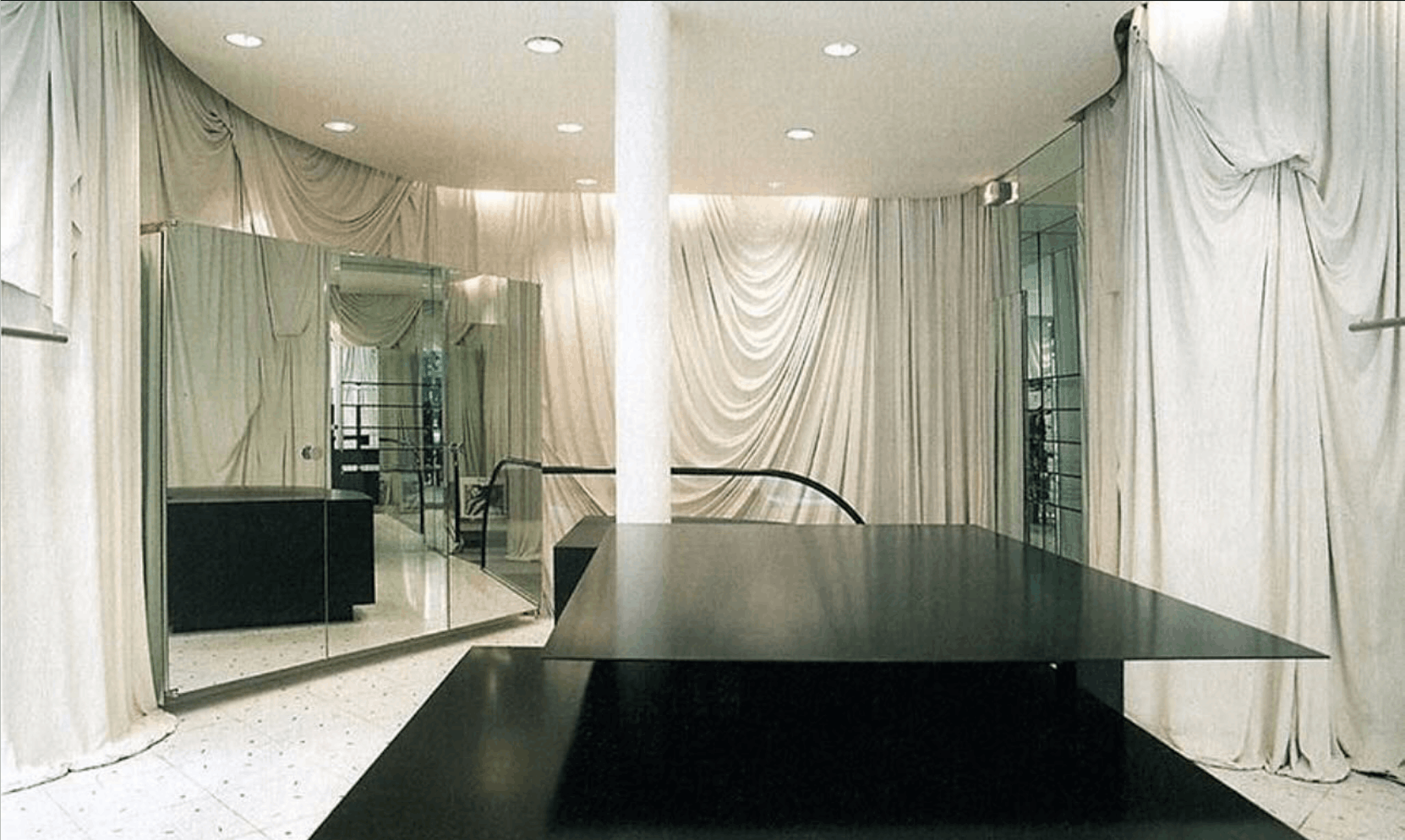
It was in this context that, in 1986, Rolf Fehlbaum, president of Vitra, commissioned from him a piece intended for production. From this collaboration was born How High the Moon, a work that would become one of Shiro Kuramata’s greatest successes and one of the icons of late 20th-century design. Its title, borrowed from a standard of American jazz notably performed by Ella Fitzgerald, immediately introduces a poetic and rhythmic dimension.
Formally, How High the Moon takes up the archetype of the club chair, a symbol of bourgeois comfort traditionally associated with the softness and thickness of upholstered leather. It nevertheless appears as a transparent and continuous volume, almost monolithic. Indeed, the chair is constructed from clearly legible curved and rectilinear planes: an arched backrest, imposing armrests, and a distinctly defined horizontal seat. The expanded steel mesh, uniformly deployed across the entire structure, acts as a filter. The chair is neither opaque nor fully transparent: it occupies an intermediate position, in which the whole is perceived more through its outline than through its surface. The short, discreet cylindrical legs slightly lift the volume off the ground. Thus conceived, How High the Moon shifts seating toward a spatial device, in which the body engages less with a material than with a relationship to void and light.

The model is produced in two main typologies: the club chair (single seat) and the sofa (two seats). The club chair, edited by Vitra in the late 1980s, enjoyed relatively wide distribution. The sofa, by contrast, occupies a distinct status. Rather than true re-editions, different phases of production can be identified. The first version, produced in 1987, was manufactured by Terada Tekkojo for Idée (Tokyo) and distributed exclusively within that context. The second version corresponds to the copper-colored model, produced in the 1990s in a limited edition of thirty examples by Ishimaru Co. Ltd. Unlike the club chair, the How High the Moon sofa is not documented as having been edited by Vitra. Some examples were nevertheless occasionally distributed in Europe and the United States through its intermediary.
On the art market and at auction, the club chair has reached relatively stable prices since the mid-2000s: around €19,000 at Christie’s in 2007, €19,000 at Piasa in 2018, €32,000 for a pair at Christie’s in 2020, or €17,412 at Phillips in 2022. These results testify to a balanced and relatively stable market.
The sofa, on the other hand, concentrates the strongest recognition. Sales at Christie’s and Sotheby’s between 2007 and 2019 range between €70,000 and €90,000, before a symbolic threshold was crossed with the record at Phillips on May 2, 2024, at €163,540 hammer price, far exceeding its estimate.

Through How High the Moon, Shiro Kuramata exemplifies the principal driving forces of his work. By diverting simple materials, he transforms a domestic object into a perceptual experience in which light, transparency, and lightness redefine the object’s presence in space, sometimes to the point of its effacement. As he said, “My strongest desire is to feel free of all gravity, of all ties. I want to float.” This aspiration runs through his entire body of work, imbued with an almost spiritual dimension.
Neither entirely furniture nor entirely sculpture, this piece is marked by a discreet poetry, a measured humor, and a constant attention to the relationship between form and material. These qualities explain why How High the Moon, like many of his minimalist creations, has established itself as an icon of design, now fully recognized and actively collected.
How high the moon
From the second half of the 20th century onward, materials originating in the first industrial age, such as steel and glass, were gradually integrated into the field of design, often diverted from their original uses. Long associated with function or heavy industry, they gradually acquired an aesthetic value of their own.
At the end of the 1980s, as minimalism established itself as a dominant language of international design, Shiro Kuramata developed a singular approach, running counter to any doctrinal rigidity. Where Western minimalism affirms the full and frontal presence of form, he explored its erasure and transparency. These elements do not serve to make the raw form disappear, but rather to modify its presence, rendering it more unstable and dependent on the surrounding space.

The model is produced in two main typologies: the club chair (single seat) and the sofa (two seats). The club chair, edited by Vitra in the late 1980s, enjoyed relatively wide distribution. The sofa, by contrast, occupies a distinct status. Rather than true re-editions, different phases of production can be identified. The first version, produced in 1987, was manufactured by Terada Tekkojo for Idée (Tokyo) and distributed exclusively within that context. The second version corresponds to the copper-colored model, produced in the 1990s in a limited edition of thirty examples by Ishimaru Co. Ltd. Unlike the club chair, the How High the Moon sofa is not documented as having been edited by Vitra. Some examples were nevertheless occasionally distributed in Europe and the United States through its intermediary.
On the art market and at auction, the club chair has reached relatively stable prices since the mid-2000s: around €19,000 at Christie’s in 2007, €19,000 at Piasa in 2018, €32,000 for a pair at Christie’s in 2020, or €17,412 at Phillips in 2022. These results testify to a balanced and relatively stable market.
The sofa, on the other hand, concentrates the strongest recognition. Sales at Christie’s and Sotheby’s between 2007 and 2019 range between €70,000 and €90,000, before a symbolic threshold was crossed with the record at Phillips on May 2, 2024, at €163,540 hammer price, far exceeding its estimate.
Lire les autres focus