Pad london 2026
October 13 – 18, 2026
For its second participation at PAD London, Pulp Galerie presents a selection of major works from the 1980s to the 2000s within a scenography conceived as a true domestic interior. Hidden behind long curtains, the booth recreates a warm and elegant atmosphere, inviting collectors and visitors to imagine the works within their own living spaces.
Featured Designers
Like the different rooms of a house, the selection is structured around the great archetypes of domestic furniture. Reinterpreted by Gaetano Pesce, Shiro Kuramata, Hilton McConnico, Garouste & Bonetti, Dan Friedman, Alessandro Mendini and Yves de la Tour d’Auvergne, these familiar forms become true icons of collectible design.
Gaetano Pesce (1939-2024)
With the Bibliothèque du VIA (1981), the Yellow P door (1994) and the Quadrata a Muro wall light (1994), Gaetano Pesce reveals the full breadth of his research on matter. Developed for the Valorisation de l’Innovation dans l’Ameublement (VIA), the bookshelf introduced a manufacturing process that allowed every edition to be unique. Designed for the offices of the Chiat\Day advertising agency in New York, the Yellow P door takes its name from the Yellow Pages directory. With Quadrata a Muro, Pesce continues his exploration of his preferred material. Its interplay of transparency and light gives the work the appearance of a contemporary stained-glass window.
Hilton McConnico (1943-2018)
A decorator as much as a designer, Hilton McConnico created Cactus (1985), a chaise longue inspired by a motif he was particularly fond of, echoing his native Tennessee. A work in which nature and furniture come together in perfect harmony.
Shiro Kuramata (1934-1991)
For Shiro Kuramata, design becomes poetic. With the Twilight side table (1985) and the Soliflore Ephemera vase (1989), the Japanese designer explores the same idea: making matter disappear. The tabletop seems to float above its metal structure, while the acrylic of the soliflore plays with transparency, leaving the flower almost suspended in space.
Elizabeth Garouste (1946 – ) & Mattia Bonetti (1952 – )
Few designers explored the cabinet as extensively as Garouste & Bonetti. Published by Néotù, the Cabinet Musique (1990) belongs to a series of cabinets that ranks among their most emblematic creations. The horn-shaped handles, twisted metal base and symmetrical composition reflect a universe inspired by ancient civilizations and traditional craftsmanship.
Dan Friedman (1945-1995)
Produced in an edition of 25 by Néotù, the Neotable coffee table (1990) freely assembles references that were central to Dan Friedman’s work. Its teardrop-shaped top, white lines recalling the counters of American diners and chrome legs inspired by the Space Age create a landscape deeply rooted in the American imagination, somewhere between Memphis, Tennessee and Las Vegas.
Yves de la Tour d’Auvergne (1927-2023)
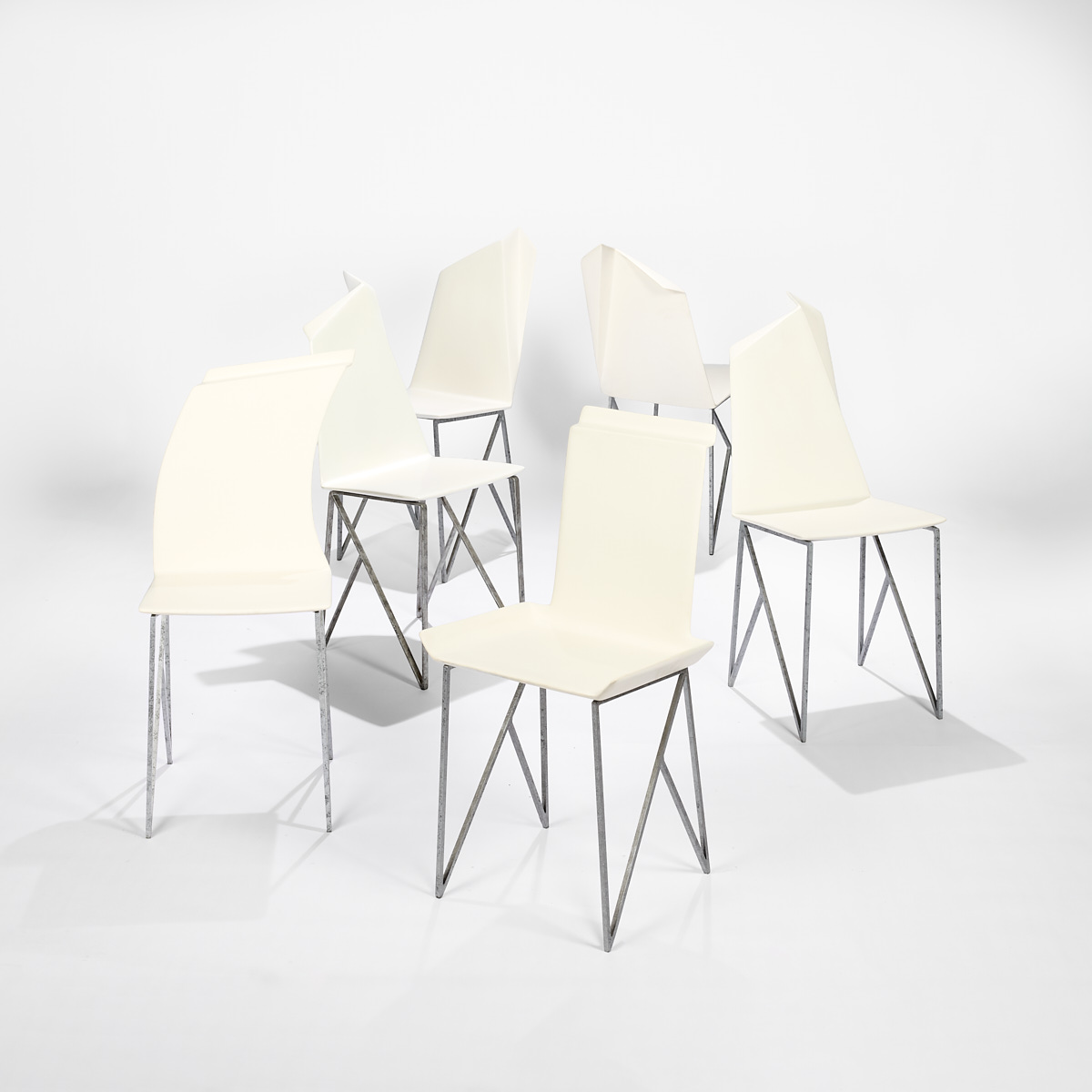
A sculptor before becoming a designer, Yves de la Tour d’Auvergne made folding the starting point of his aesthetic. Crafted in patinated metal and marble powder, the Roma floor lamp (1985) evokes an origami form whose folds seem to emerge naturally from the material. By giving marble the appearance of paper, he allows light to reveal its folds and volumes.
A Refined Scenography
Designed by Hugo Travaux and Cyrille Van Dievoet (Gorylle Studio), the scenography draws inspiration from the codes of a contemporary interior. Long curtains and cream tones create a refined, intimate and elegant setting.
Available pieces