The Cactus in Hilton McConnico's Work
Few motifs run as consistently through Hilton McConnico’s work as the cactus. From the mid-1980s onwards, it appeared across furniture, textiles, glass and sculpture alike. Rather than reproducing the same form from one creation to the next, McConnico explored the many possibilities offered by this plant through different materials, techniques and scales, ultimately making it one of the most distinctive motifs in his body of work.


This recurring motif is rooted in an imagery that is both deeply American and profoundly personal. The desert landscapes of Arizona, cacti, vivid colours and the light of the American Southwest all shaped a visual universe that is instantly recognisable. Danielle Rapoport refers to this as a “solar effect”, adding that his work “borrowed greatly from the vitalism of an America yet to be built.” This America was far from an abstract notion. According to Jacqueline McConnico, the designer’s wife, his creations “very often drew their roots from his childhood memories.” The bold fields of colour that define his work directly recall the brightly painted façades of the houses in his hometown of Memphis, Tennessee. More than a geographical place, America became, for Hilton McConnico, an aesthetic language in which colour, light and form combined to create a singular landscape.
This universe also recalls the aesthetic of Hollywood Regency, the American decorative style inspired by the lavish sets of Hollywood cinema. Developed during the 1970s, it embraced vibrant colours, an eclectic mix of influences and a theatrical approach in which furniture, objects and architecture all contributed to the same staged environment. Without ever being confined to this style, Hilton McConnico shared this way of conceiving both his objects and his interiors.
The Cactus chaise Longue (1985) is one of the earliest expressions of this approach. Here, the cactus does not simply decorate the piece: its gilded silhouettes become part of the very structure of the chaise longue, creating a composition that combines opulence with comfort.


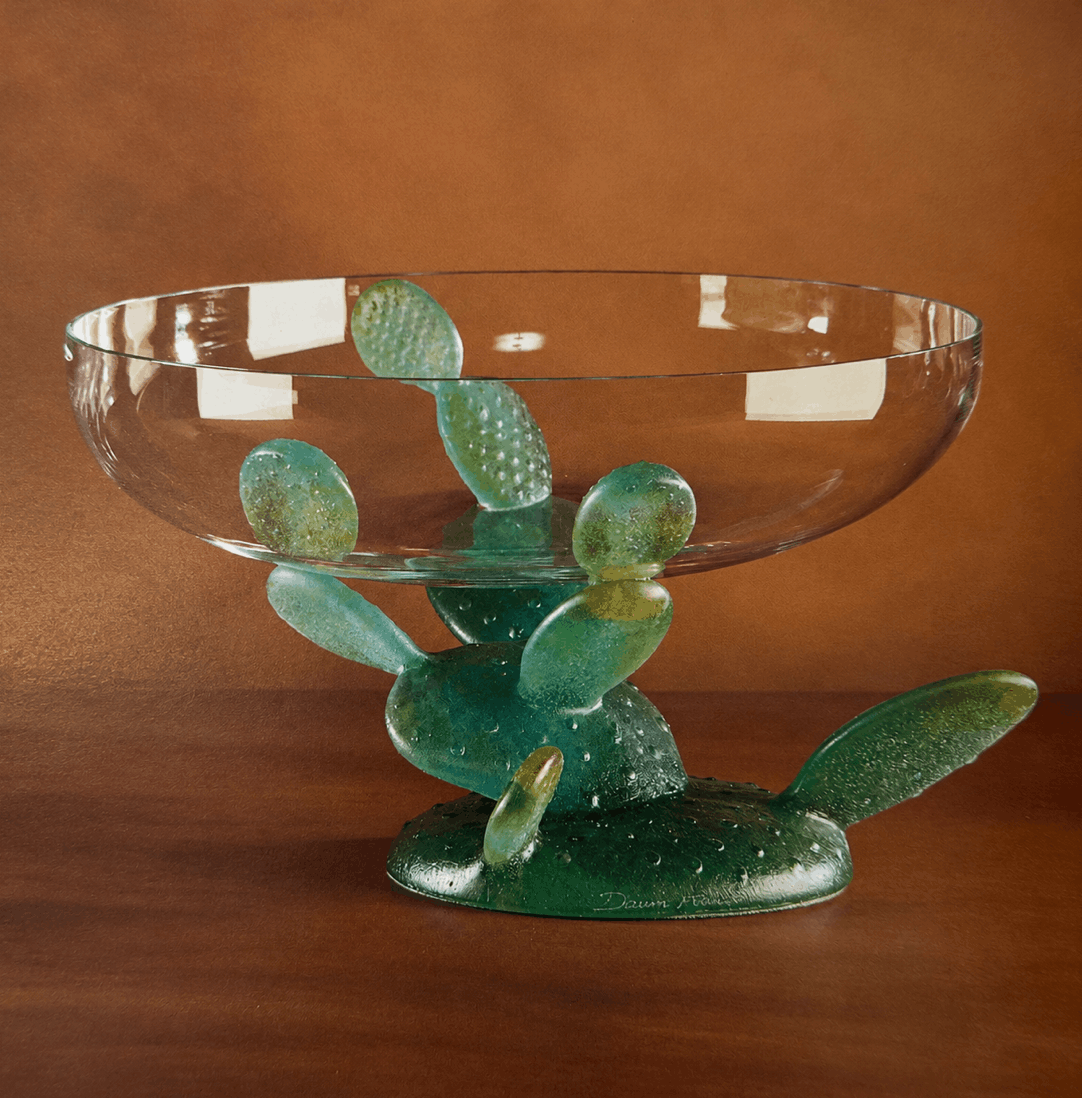
From 1987 onwards, McConnico expanded this exploration through his collaboration with Daum, which allowed him to extend his cactus vocabulary into the realm of tableware. The Cactus bottles and Arizona bowls were among the first creations of this series. The cactus became, in turn, a decanter stopper, the base of a bowl or a sculptural crystal element, with the same motif adapted to distinctly different functions.
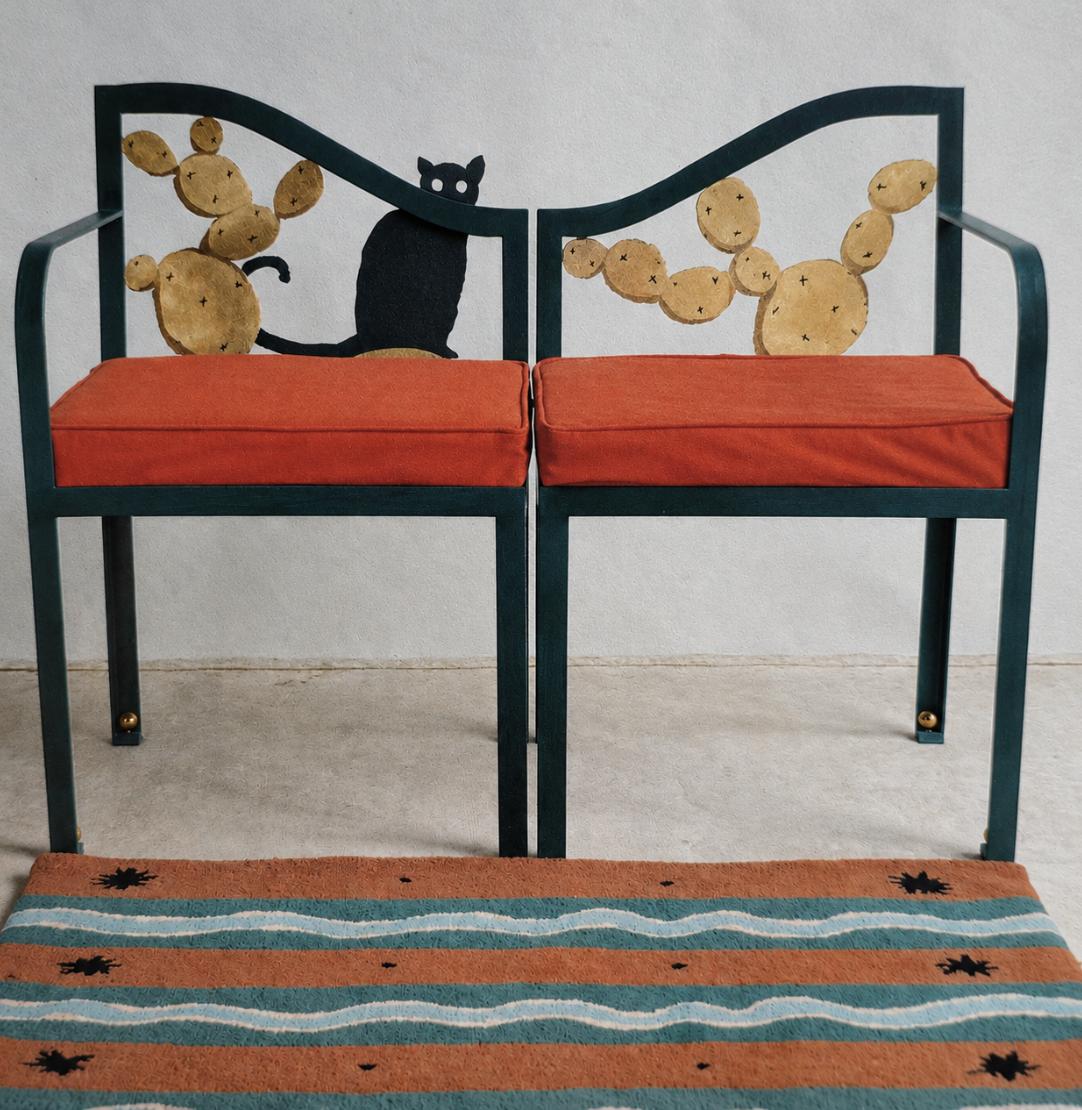
This exploration continued with several Sculptures-Volumes in pâte de verre, produced by Daum Frères & Cie, in which the plant became a sculpture in its own right. In 1989, McConnico also created a version in gold leaf, before the Arizona Right and Arizona Sunset rugs, designed around 1990 for Toulemonde Bochart, extended this investigation into the field of textiles. The motif would go on to appear in yet other typologies, including mirrors created with glassmaker Guillaume Saalburg and ceramic tiles produced by Carocim, demonstrating that, for Hilton McConnico, the cactus was never confined to a single discipline.
How can a chaise longue, a crystal bowl, a pâte de verre sculpture and a rug feel so closely related? Perhaps because they all emerge from the same imaginative world. Cacti therefore occupy a central place in Hilton McConnico’s work, serving as a reminder of his native Tennessee and, more broadly, of his enduring attachment to the American imagination. Yet they represent only one facet of a far richer creative practice. Decorator, scenographer, designer and inventor of forms, Hilton McConnico never ceased to imagine new worlds, each as significant as the next. Perhaps this is his greatest singularity: his ability to repeat himself and reinvent himself in equal measure, without either ever diminishing the other. In his own way, he remains one of the most visionary image-makers of the Eighties.

Read the other focus