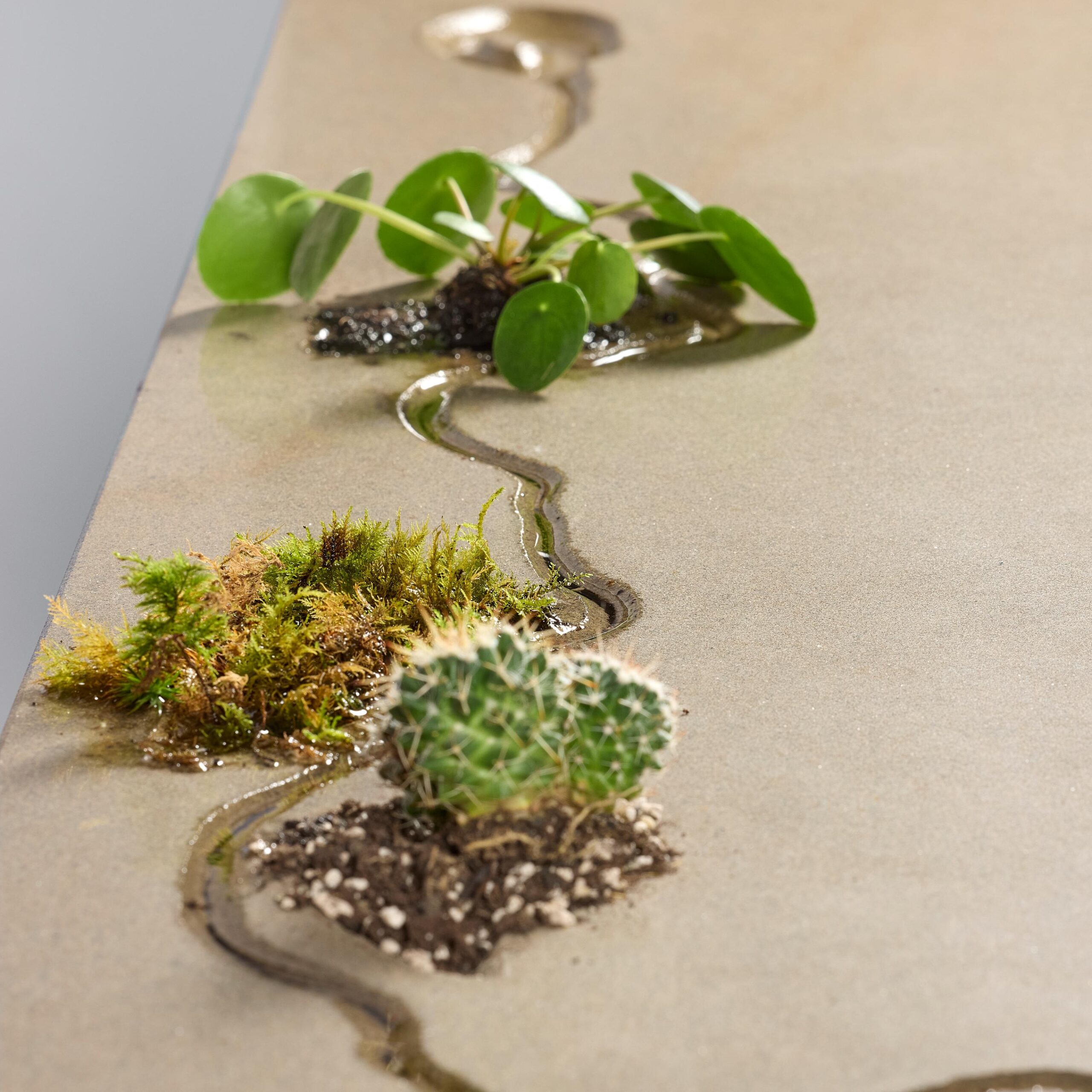
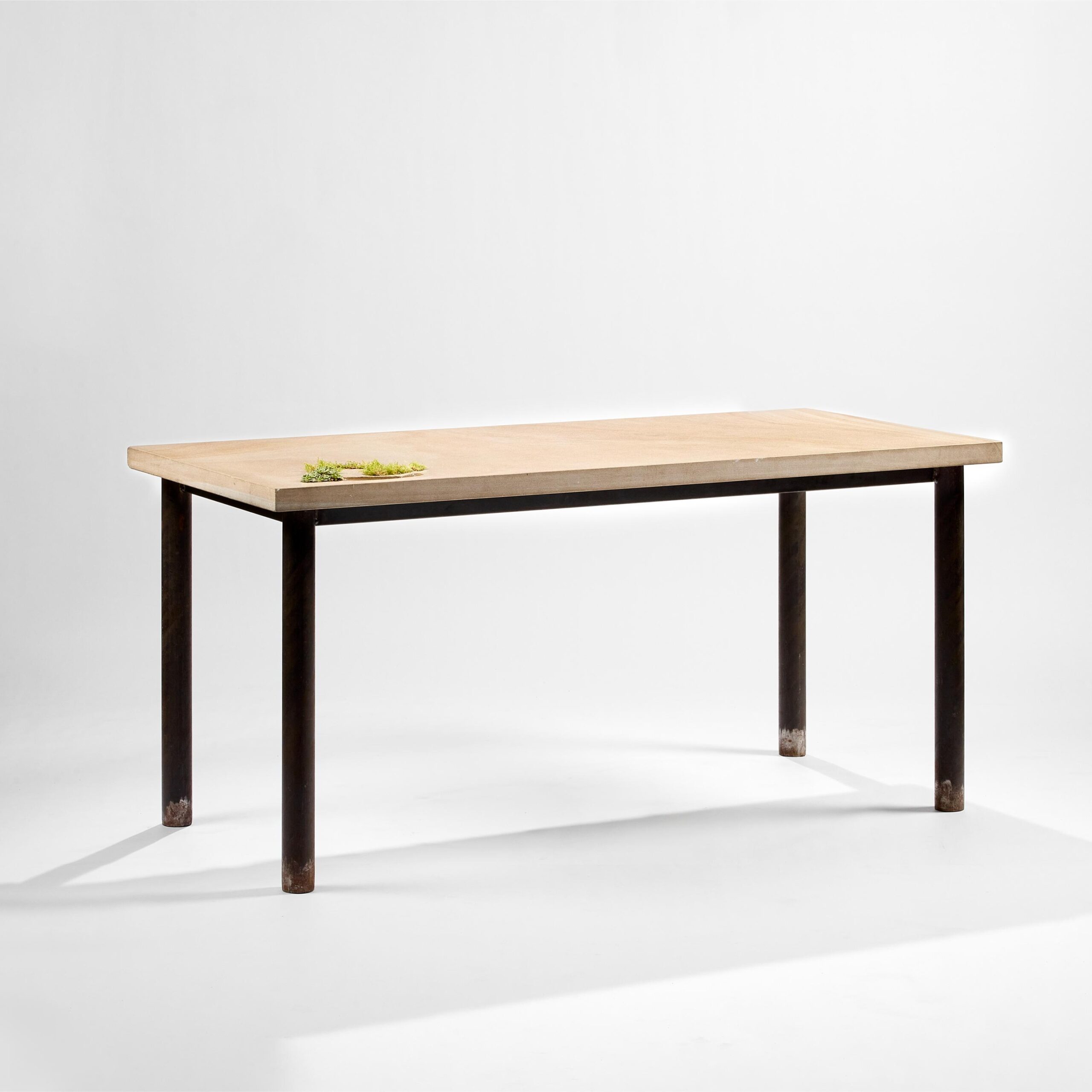
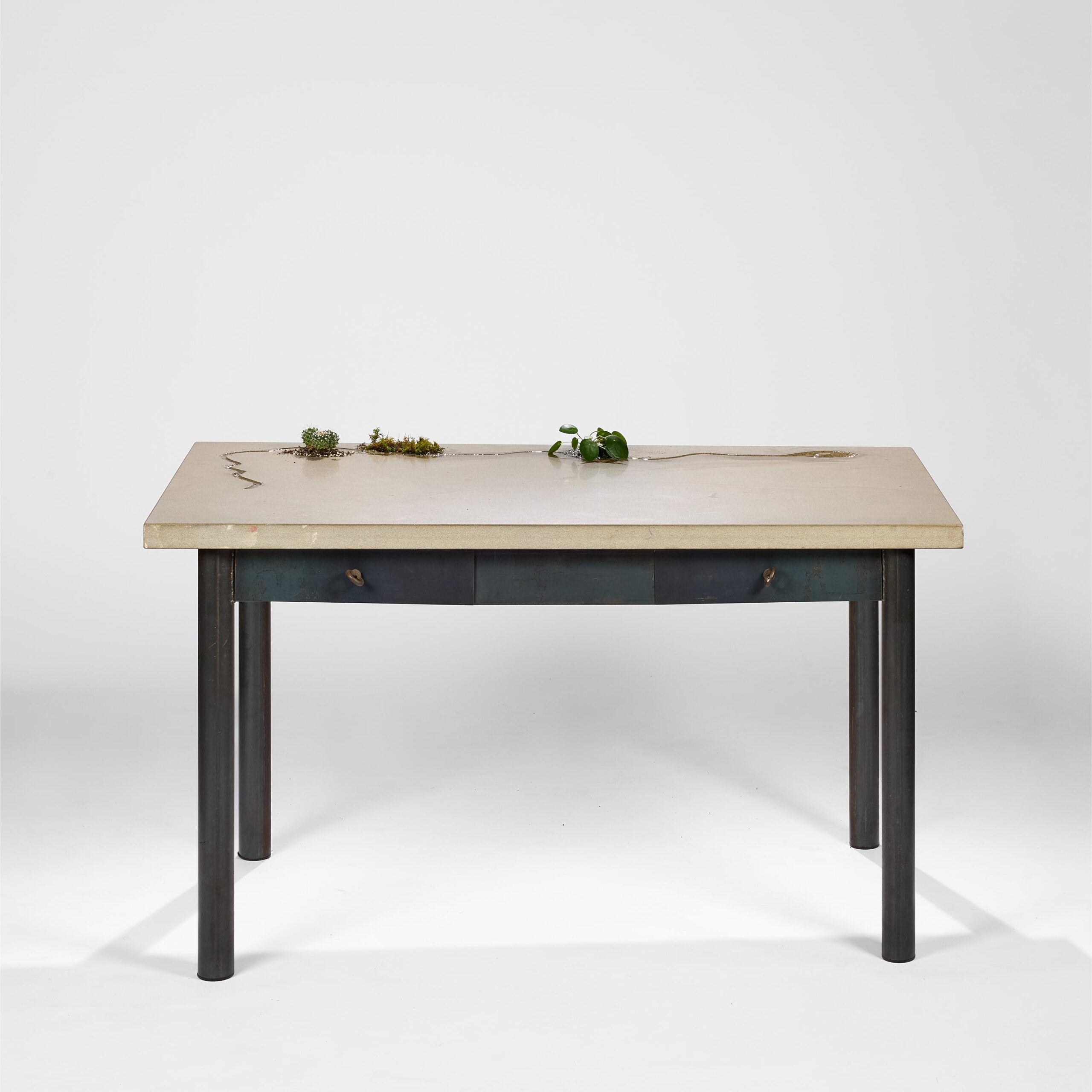
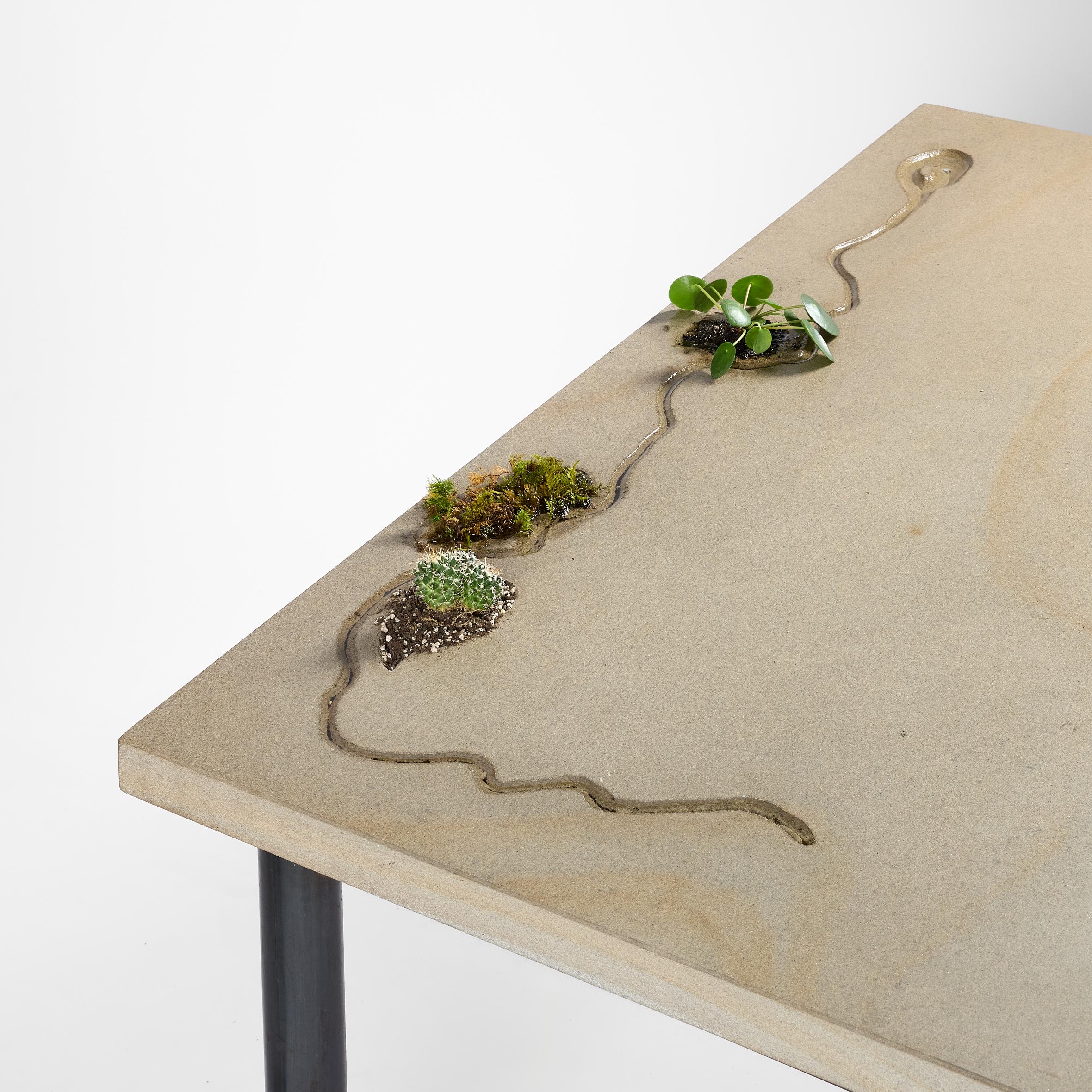
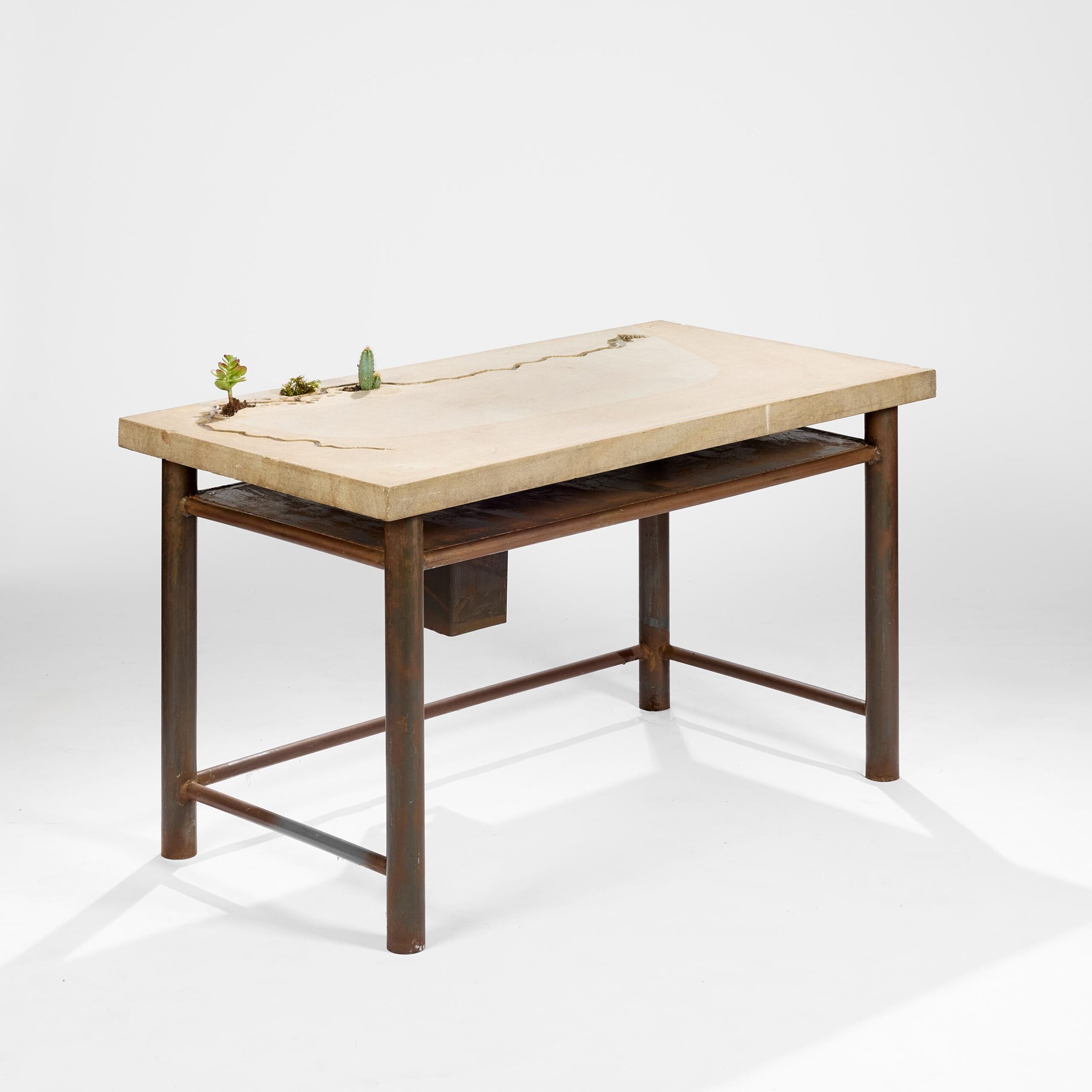
The lines carved into the stone evoke the meanders of well-known waterways, from the Grand Canal of Venice to the broader curves of the Amazon, as well as the Rhine, which flows through the Cologne region. Each piece thus appears as a form of landscape reduced to the scale of furniture. In these works, the surface of the tabletop ceases to be a flat, purely functional plane.

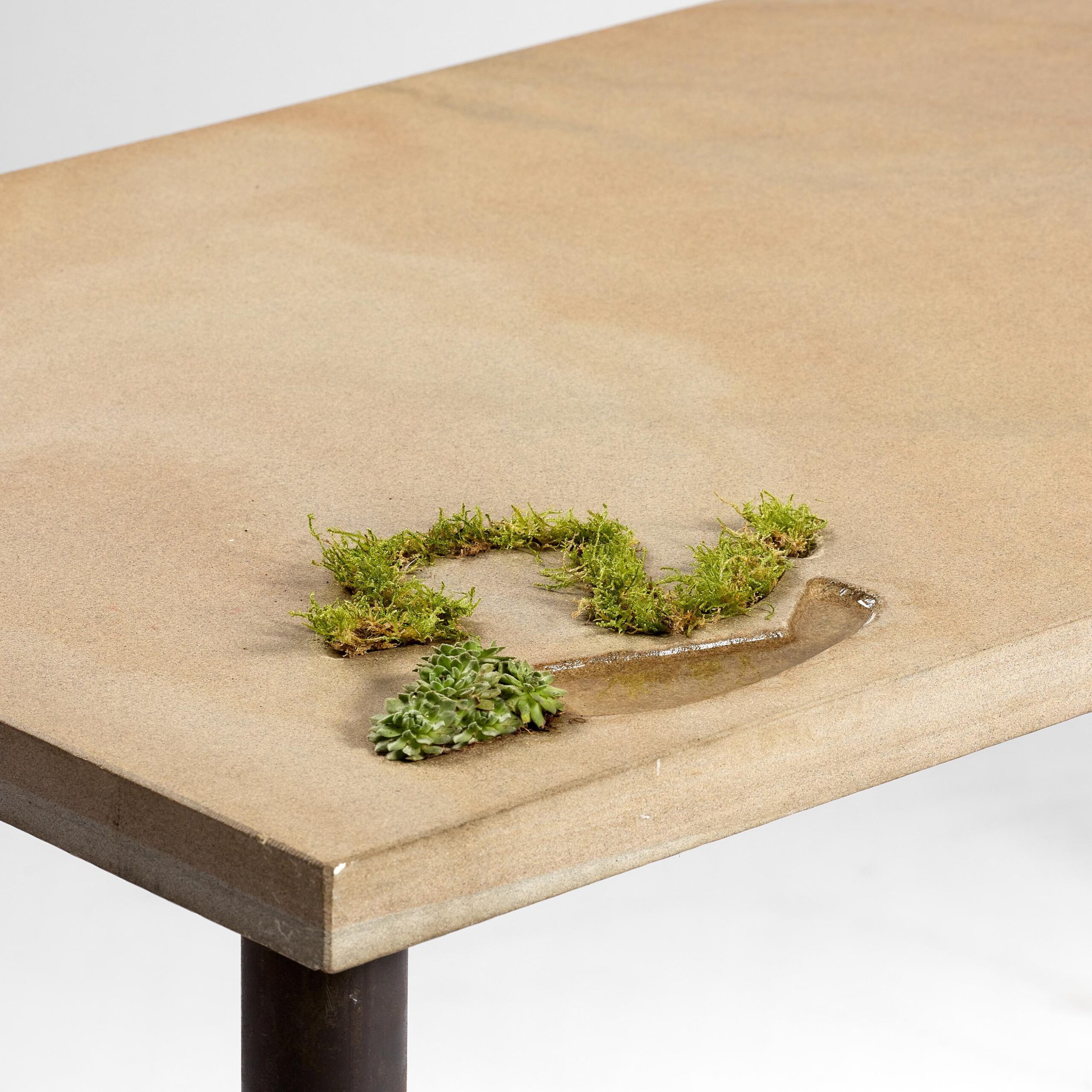
It is cut through by a sinuous channel that recalls the course of a river. This sculptural gesture introduces an almost cartographic dimension to the object: the desk or table becomes a miniature topography in which form directly evokes the imagery of landscape. This line is carved into a slab made from Ruhr river sandstone, a local stone easily accessible to designers working near Cologne.

This mineral material anchors the object in its geographical context. Its sandy texture and natural tone evoke soils shaped by water. The whole rests on a metal base, recalling both the industrial heritage of the region and the distinctive aesthetic language of Pentagon Gruppe’s creations. Yet these pieces are not limited to a purely formal reference to rivers.

As demonstrated by the Amazonas desk, designed in 1988, the tabletop also incorporates a genuine water circulation system. A small pump hidden within the structure allows water to flow through the channel carved into the stone. This mechanism irrigates the plants arranged along the line of the tabletop and transforms the surface into a living space.

The same mechanism also appears in the Canal Grande di Venezia table, whose layout follows the curves of the famous waterway surrounding Venice. The channel carved into the stone becomes a surface for intervention, where moss and plants can be freely arranged, allowing the creation of miniature landscapes.

The furniture thus becomes a true field of experimentation. The object ceases to be a neutral surface and turns into an evolving space, where the presence of water and vegetation introduces a poetic dimension into the working environment. Through these desks and tables, Wolfgang Laubersheimer proposes a different way of thinking about furniture, in which the function of the desk or table intertwines with a sensitive evocation of the river landscape.

An Ode to the Great Rivers

In the late 1980s, at a time when office furniture was still largely dominated by logics of standardization, the German designer Wolfgang Laubersheimer, founding member of the Pentagon Gruppe, developed a distinctive approach to the tabletop. His desks and tables draw inspiration from the courses of the world’s great rivers.

It is cut through by a sinuous channel that recalls the course of a river. This sculptural gesture introduces an almost cartographic dimension to the object: the desk or table becomes a miniature topography in which form directly evokes the imagery of landscape. This line is carved into a slab made from Ruhr river sandstone, a local stone easily accessible to designers working near Cologne.

As demonstrated by the Amazonas desk, designed in 1988, the tabletop also incorporates a genuine water circulation system. A small pump hidden within the structure allows water to flow through the channel carved into the stone. This mechanism irrigates the plants arranged along the line of the tabletop and transforms the surface into a living space.

The same mechanism also appears in the Canal Grande di Venezia table, whose layout follows the curves of the famous waterway surrounding Venice. The channel carved into the stone becomes a surface for intervention, where moss and plants can be freely arranged, allowing the creation of miniature landscapes.

The furniture thus becomes a true field of experimentation. The object ceases to be a neutral surface and turns into an evolving space, where the presence of water and vegetation introduces a poetic dimension into the working environment. Through these desks and tables, Wolfgang Laubersheimer proposes a different way of thinking about furniture, in which the function of the desk or table intertwines with a sensitive evocation of the river landscape.

Read the other focus

The
Café
Casino

Unikate,
the roots
of Pentagon

Gerd

Arens

Meyer
Voggenreiter

Ralph
Sommer

Reinhard
Müller

Wolfgang
Laubersheimer

Design Gruppe
Pentagon – MAKK