

Even before making a purchase, the visitor already experiences the brand. This idea guides the project designed by Shiro Kuramata in 1983 for the Issey Miyake boutique in Saint-Germain-des-Prés, Paris. He conceived something far beyond a simple retail space. Faithful to his approach to design, he sought to make the boutique a place shaped by material and light. Far from the traditional codes of fashion retail, he created a pared-down interior whose identity relies less on decoration than on the quality of surfaces, volumes, and atmosphere.
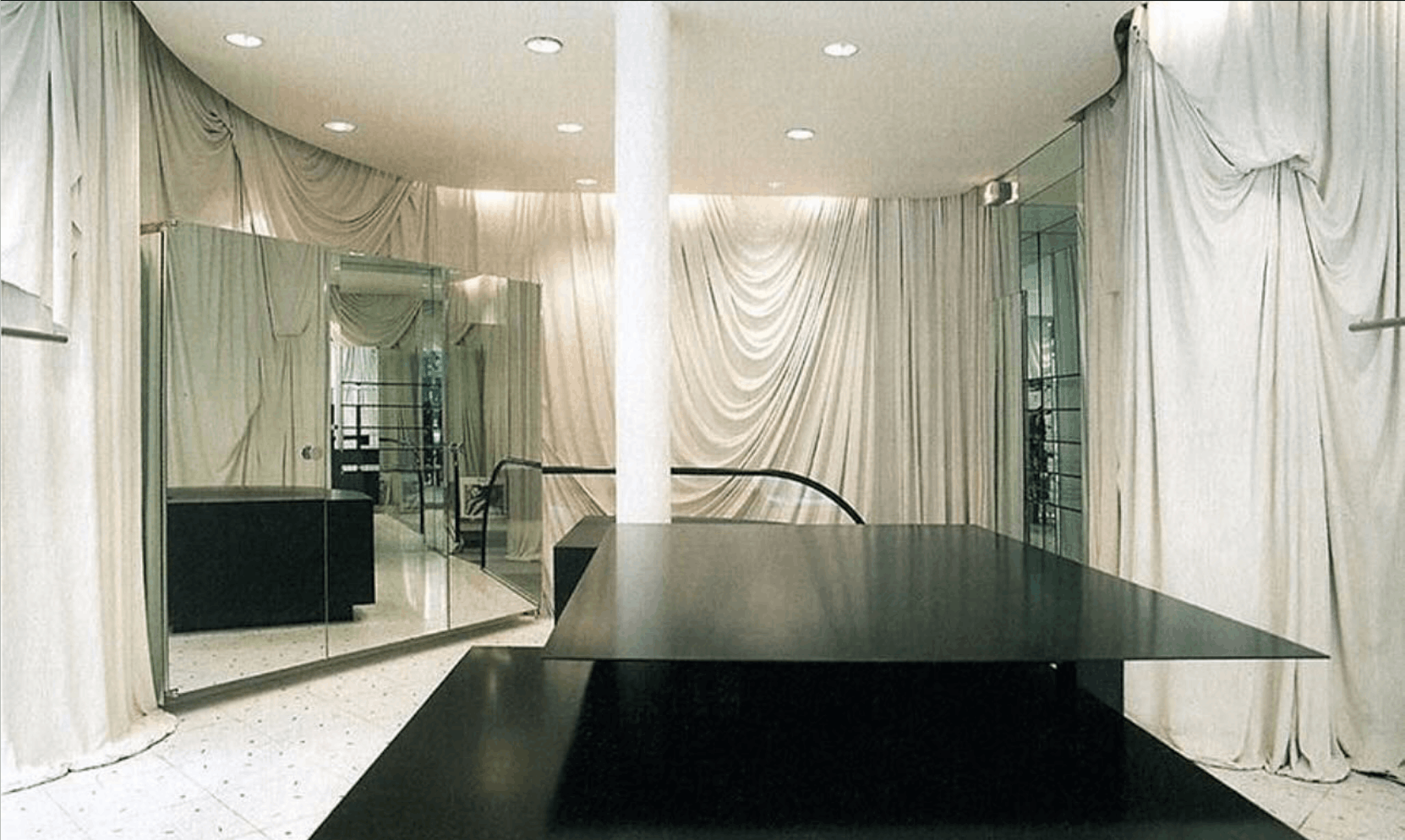

At the heart of the project appears Star Piece terrazzo, a material designed and named by Shiro Kuramata. Developed from concrete mixed with fragments of colored glass, it is used for the floor. The irregular distribution of the fragments produces a non-repetitive, ever-changing pattern that captures light and animates the space. Kuramata had been exploring terrazzo for several years. After initial experiments incorporating stainless steel shavings, he developed here a brighter version, which he then used in several projects for Issey Miyake, as well as in several pieces of furniture designed in 1983, such as the Kyoto, Nara, and Tokyo tables.
The project also includes large draped elements fixed to the walls, made from fabric stiffened with acrylic resin and then painted. Having become solid, they nevertheless retain the supple appearance of fabric. Produced in Paris, then cut and reassembled on site, these elements give the boutique a particularly unique presence. Textile, usually associated with clothing, here finds its place within interior architecture. Black display platforms, as well as a counter, complete the ensemble.
The choice of Saint-Germain-des-Prés is not incidental. By opening this boutique in Paris, Issey Miyake asserts the place of contemporary Japanese creation on the international stage. Kuramata designs a space capable of fitting into the Parisian landscape without adopting its traditional codes.


This collaboration also continues in other boutiques. In 1984, for Issey Miyake at Bergdorf Goodman in New York, he developed a new variation of terrazzo, this time composed of fragments of Coca-Cola bottles. Some backlit walls made the glass fragments sparkle like stars. Here again, material becomes a central element of the identity of the space.
In 1987, for the Issey Miyake Men boutique in Shibuya, Tokyo, Shiro Kuramata pushed this experimental dimension even further. Inspired by his How High the Moon chair, he transformed the principle of metal mesh into a true interior architecture. The space then takes the form of a long rectangular cage, intersected by a second structure, creating the image of a cage within a cage. The superposition of the meshes produced a shimmering effect, which Shiro Kuramata described as a light rain in the sun. The boutique thus becomes less a simple place of sale than a space where light, transparency, and structure transform the perception of the place.
This attention to space can be found in other projects carried out by Shiro Kuramata during the 1970s and 1980s. As early as 1974, with Milk and Milk Boy in Tokyo, he was already interested in the way an interior can convey the image of a brand through layout and materials. This research continues with Esprit House, completed in Tokyo in 1983. Conceived as a guest house for the brand, it combines domestic space and contemporary design: Star Piece terrazzo covers the main rooms, large bay windows open the interior onto the garden, while a Japanese-inspired room takes up the codes of the traditional tea room.
Through these architectural projects, Shiro Kuramata shows that the boutique can be something other than a simple place of sale. It becomes an extension of a brand’s identity and a field of experimentation for design.

Lire les autres focus


