Interview with Yves de la Tour d’Auvergne by Catherine Paradeise (1982)
Catherine Paradeise – How did you come to make the transition from your painting with its abundance of themes, to your sculpture which reduces the work to its bare essentials?
Yves de la Tour d’Auvergne – For a painter light is not the same as for a sculptor. For a painter, light must
originate from the canvas. For a sculptor, light must glide over the object. When I was doing highly structured forms, which were at once bird’s eye views and cross-sections, it was already obvious that I wanted to reproduce everything I could see in nature.
I wanted to reproduce this vision, in my Paris studio, through its large windows, and its garden, which gave me a vision of aluminum structures and the reflection from both the exterior and the interior of the patio.
All this was fragmented, reflected again in the window glass, redivided and transformed into something highly architectural. Yet I always sensed something artificial in painting, plans of escape, representations of nature, dream cities, aerial cities or the ruins of cities I myself destroyed and recreated.
I experienced a feeling of frustration because I could never see what was hidden on the other side of the canvas.
I could have used perspective, but it did not seem to be enough… and the void gradually took over, leaving only the main arteries, shapes which were somewhat geometrical, the archetypes… the residue of all I had assimilated.
I then had an intuitive feeling that I could render these ideas through the medium of stone. I had in mind all the monuments of the Middle East, particularly those of Petra. In stone I rediscovered what I had tried to do in painting, emphasizing the random element by the « survival of the fittest » method. I was looking for very precise shapes, keeping their splinters, and accentuating this quality to make them even more immediate, like monuments perceived by the moving eye.


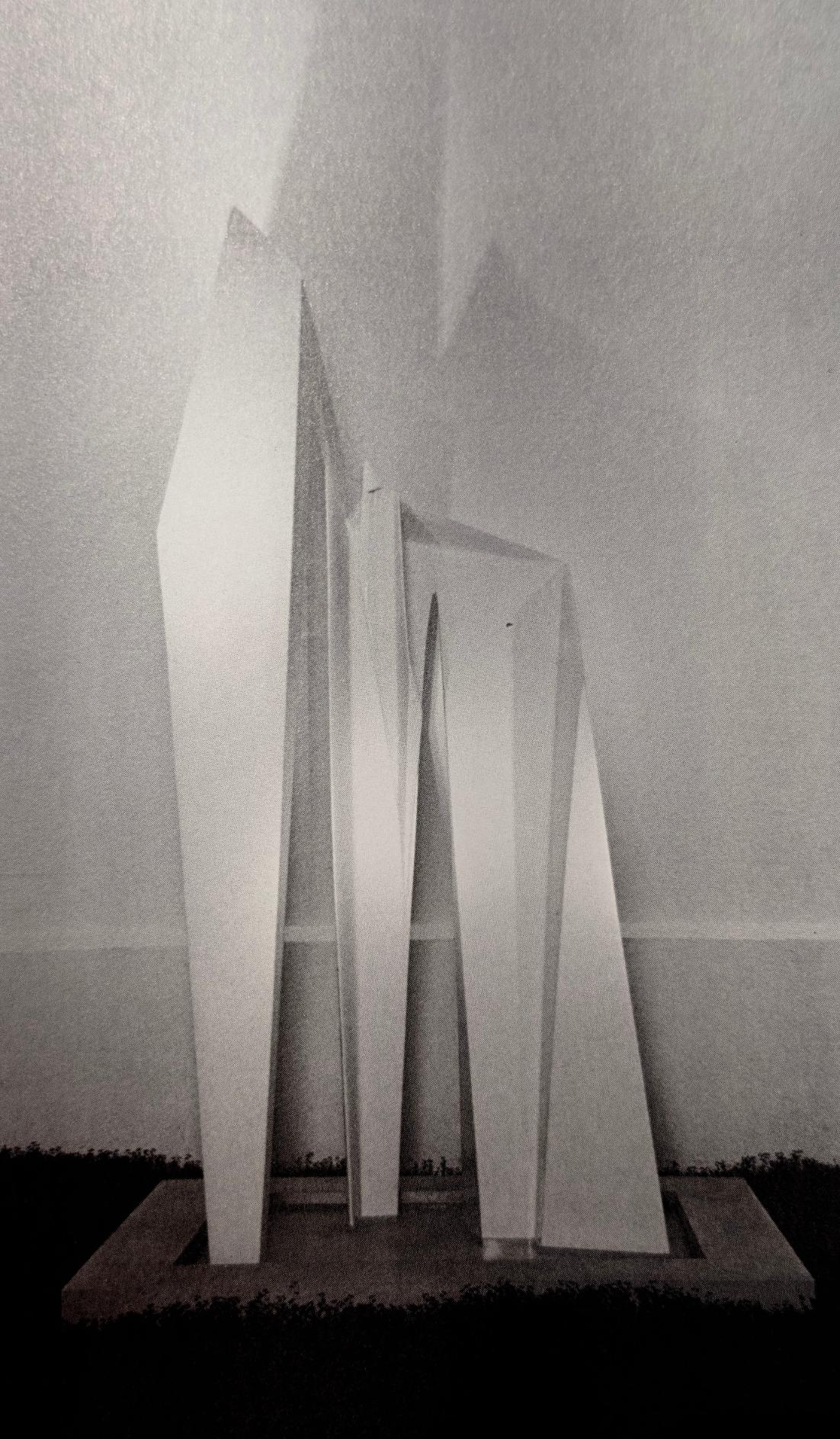
At this juncture, I had an accident which left me inactive for several months. Flat on my back, I thought about the thing that had interested me for a long time: paper. For me paper is a noble medium, with a whole cultural background and great emotional significance. Paper is a grid, a medium of thought. It is blank, and one can do what one wishes with it. Indeed, I found white canvas superb. Paper is a whole, it is worked by hand, it is pure, a sublime surface. Also, it was my first cultural medium. My childhood memories were not of Rembrandt or Velasquez, but of folded paper shapes. Neither the origins nor the originator of such paper constructions are known, but we still make paper planes, rockets, birds and boats. It is the first thing you do with your hands. I then decided to try to create very pure, simple forms by folding (if there are collages, then why not “foldages , or folded paper constructions?) These forms were to be an alliance of strength, lightness and fragility, hope extended in paper.
I began work, and I began tearing. The advantage of paper is that you can tear it. I began with wall reliefs. Then, bit by bit I discovered shapes more in tune with my sensitivity and ideas, and with my whole development.
I made the first “foldages” vertical, then horizontal with openings, large soaring forms.
This was the transition between the sizeable somewhat empty canvasses I had done earlier, and the work I am now exhibiting. The difference is that I have had to transfer my folded objects into more solid materials, since paper is not robust enough. Still I reserve the right to exhibit very small, hand-sized paper objects in the future.
Catherine Paradeise – Forms, archetypes, lines, forces; a whole series of concepts which relate to the central idea of structure. Structure, structuralism: how has your experience in the social sciences been incorporated into your work?
Yves de la Tour d’Auvergne – Structure, yes. Sculpture is a word I use out of convenience. In the sense in which I understand the word, which is undoubtedly not its true meaning, I do not create sculptures. For me, sculpture evokes full forms with some reference to representation.
I use the term structure in an architectural and “structuralist’ sense, with a central concept of relationship and balance. My works are structures in the empirical sense, and they are structuralist because if one element is altered, they collapse.
Truly, collapse. I am always on extreme limits of balance. I believe that an artist is an intermediary. He takes what he perceives from the external world, then transforms and reworks it internally.
Nothing is determining, but everything is important. In 1978 I had the idea that I could take the diagrams and charts I saw in your thesis as a model, rather than using a nude or a landscape, and taking them in their entirely, in order to create a form that would give artistic dignity to these objects. Is a beautiful chart not a beautiful thing?
Can sociological facts not be turned into works of art? A revelation of the mobility of facts by shadow play. That which seemed abstract would be transmuted into a work of art. That abstraction would become a reality, I would reach that intersection where scientific and artistic languages unite. In this way I designed the first « formal sociological spaces ».
I then quickly realized that in choosing the beauty of a diagram in which the esthetic concept would prevail, I would be forced to make a statement which, for the sake of coherence, would be untrue. Consequently, I abandoned this point of reference.
In this way I was forced to conceive of a form which, although detached from sociology, was nonetheless a manifestation of it.
Catherine Paradeise – Starting with stone, you find something more than in canvas; but the stone resists; and so you move on to a material over which you can exert greater control…
Yves de la Tour d’Auvergne – Yes… The material relationship between paper and the hand is something which is at once simple, pleasant and final; simple because paper folds easily; it is pleasant because it is solid enough, without possessing the rigidity of steel.
Paper is right for the hand. My sensitivity can be immediately materialized on paper. The relationship between paper and the hand creates an harmonious quality in space. Paper can be cut, it can be divided into pieces.
However, with rare exceptions (immense surfaces, which are too large for my formats), I avoid collage. Generally the paper is folded and razor-out in one action. This enables me to create a continuous variation. The means are deliberately limited, but within these limits there are many possibilities of movement and resonance. Instead of painting nature on paper, I make a large « foliage », which encompasses nature. I inverse it and create a certain ambiguity. I you look at a conventional nude from behind, you known in advance that you will see what you had already imagined from the front. In the same way, if you see a neck, you know there will be a face.
With “foldages”, you have to take the long way around, because you cannot guess the entirety.
The shadow is never the same. It creates a continuous variation, originating in the rhythm of folding, and not in what can be divined from he side you see.
In open structures, part of nature incorporated into the “foldage”.


My sculpture is a kind of prism. It fits into a space and then part of that space rearranges itself around it.
I went from stone to paper because paper seemed to be a finished product.
The blank space is blank, and the folds project shadows. Here we arrive at the problem of polychromy, with the aim, in sculpture, of restoring the faithfulness of representation.
I took the opposite course, employ shadows.
The whole is the same, but according to the light inside, the form the shadows give birth to creates another echo, an echo of a silence.
Mendelbrot’s work on “fractal objects” provides a theoretical backup to what I was practicing. The universe alters, there is a shift which I can recreate through the technique of folding.
I find the maximum lightness in tension, a tension similar to the emotion following the music immediately before the audience applauds. The orchestra stops… silence… tension… It is my belief that if this tension can be felt by the lone spectator, the work is then completed. This is why I keep my work in reserve for a long time, to make sure the emotion remains. If the feeling is lost, rework is incomplete. The piece is steel in need of work, indeed up the limit of destruction. I do not want to add. To create is to eliminate.
Catherine Paradeise – What is your main obstacle?
Yves de la Tour d’Auvergne – The difficulty is not in conception, but rather in adopting the daily habit of creating. The work, the discipline, this daily practice…
Because it is a daily practice. The relationship I have with an object, with paper, this sustained connection, is of the utmost importance. It is essential that I feel this. I want the spectator also to perceive this rigor and this simplicity.
Catherine Paradeise – What about other materials: resin, marble, bronze?
Yves de la Tour d’Auvergne – At one tome I tried bronze sculptures; but bronze implies something moribund. I am mow using other materials, resin and marble powder.
They suit me better and they give to “foldage” the classical qualities of polish and finish. Yet they do not cry: “look, I’m made of bronze, I’m eternal”.
My works are very mortal. I want fragility. I have been looking for this from the outset.
I believed that I could find an equivalent of paper in other materials, and still retain the essential qualities: emptiness, exactness of fold and fineness.
Catherine Paradeise – You speak of balance, of a tension or force drawing you towards purity, a kind of truth, whose face changes like light on the object…
Yves de la Tour d’Auvergne – I am talking about artistic truth. As for purity, this is not the emphatic purity of the soul.
It is candour. The truth of what is best in childhood has to be rediscovered, the truth of the child who is ready to believe, in communion with the elements, which is also a tension, or attracting force/ I am much aware of what Chinese painting has given me: the humility that pervades an artist who looks at a landscape for years, and then paints it in one session, as if because of an overriding necessity. This is an internalization of all experience, happiness, suffering, the otherness we carry within. All this experience in an object. Why that one rather than another?
Why a field of tulips rather than poppies? An overriding necessity born of a whole interrelated series of feelings and knowledge.
Catherine Paradeise – And what about the public?
Yves de la Tour d’Auvergne – Art is not obligatory. What is the artist’s role? Does an artist know the answer to this himself? The artist’s role is, I believe, not to shock, but to show people that the things in which they believe are not quite where or what they think they are. Using ever more pellucid means, I am at the dividing line between classical and conceptual art.
What do I want? I want to say: look at these sheet of paper. It is folded. Gaze at it in silence, in light. It is the reflection of your thought, it is you. It is the you of another time when all things were possible. And what have you become?
—
Interview conducted by Catherine Paradeise
Assistant Professor, University of Nantes

Read the other focus