Yves de la Tour d'Auvergne: Provenance and Collections
The collections that have housed the works of Yves de la Tour d’Auvergne reflect the diversity of perspectives brought to his work. Paintings, furniture, Sculptures-Volumes, and outdoor sculptures have found their place in collections of very different kinds. Art dealers, decorators, architects, collectors, and admirers of monumental sculpture have each, in turn, recognized a different facet of his work.
The artist’s earliest paintings were notably part of the former collection of Abbé Morel. This provenance reminds us that, long before developing his vocabulary of the fold, Yves de la Tour d’Auvergne was first recognized as a painter. It was then a Sculpture-Volume that entered the collection of Jean-Claude Bellier. An art dealer, expert, and collector, Bellier was one of the leading figures of the French art market at the time. His interest in modern art was accompanied by an important collection of African and Oceanic art, to which was added a Sculpture-Volume by Yves de la Tour d’Auvergne.


During the 1980s and 1990s, appreciation of his work extended beyond the circle of collectors. Interior decorator Isabelle Hebey, known for her work on the interiors of the Concorde and the first Yves Saint Laurent boutiques, conceived an important interior project for the apartment of Mr. and Mrs. B. in Paris’s 8th arrondissement. She incorporated several works by Yves de la Tour d’Auvergne, including a monumental corrugated cardboard relief, Sculptures-Volumes, and furniture, among them a sculptural floor lamp and stools. These works did more than simply furnish the space: they became part of a broader project in which architecture, design, and art formed a coherent whole.
While furniture and Sculptures-Volumes naturally found their place in interior settings, from the 1980s onwards the vocabulary of the fold gradually moved beyond the domestic sphere to inhabit gardens and large estates.
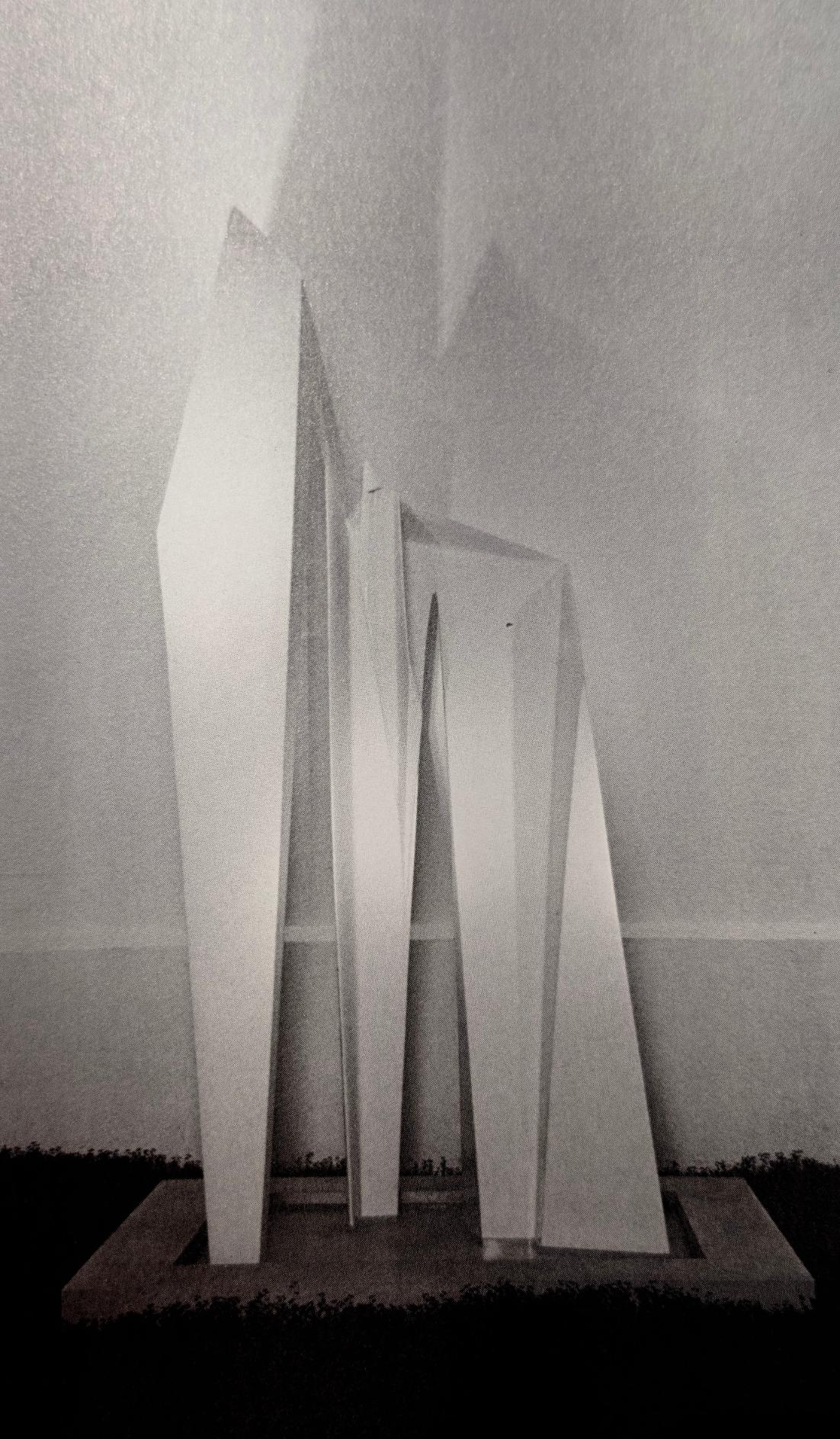
The collection of Masahko Sawada provides a striking example. At the Haras de l’Ermitage in Aunou-le-Faucon, Normandy, this Japanese collector assembled an exceptional collection of contemporary outdoor sculpture. Transformed into a vast sculpture park, the estate brought together works by Martha Pan, Michael Heizer, Pascal Morabito, Florin Codre, and Yves de la Tour d’Auvergne. Among them was Les Veilleurs de Lune (1990), a monumental sculpture composed of three elements rising to nearly ten metres in height. Displayed there until the collection was dispersed at auction in 2018, the work confirmed Yves de la Tour d’Auvergne’s place among the leading sculptors of his generation.


His sculptures were also installed at the Haras d’Estimauville, owned by the Rothschild family. Set within the park of the estate, they accompanied both the architecture and the Norman landscape. In 2010, Christie’s dispersed part of the estate’s collection in the sale Le Haras d’Estimauville. Œuvres et Objets d’Art provenant des Collections Rothschild. Among the works offered were two monumental Sculptures-Volumes by Yves de la Tour d’Auvergne: one in black-patinated resin, rising to nearly five metres in height and estimated at €20,000–30,000; the other, a unique work in lacquered resin, estimated at €15,000–20,000.
The sale Le Cabinet de curiosités de Jean-Pierre Jouve, organised by Osenat in 2019, offers a final example of this diversity. Chief Architect of Historic Monuments, Jean-Pierre Jouve had assembled several works by Yves de la Tour d’Auvergne, including two monumental sculptures, a pair of stools, a lamp, a pair of candlesticks, and two paper collages. More than a particular period or medium, it seems to have been the artist’s entire approach that attracted his interest.
Over the years, these provenances have drawn an unexpected portrait of the artist. They show that Yves de la Tour d’Auvergne was never collected for only one aspect of his work: some sought the painter, others the sculptor or the furniture designer. Each collection reveals a different dimension of his practice, without ever exhausting its richness. More than simple provenances, these collections tell the story of an artist whose works continue to circulate and attract new generations of collectors.

Read the other focus