

Visit to Yves de La Tour d’Auvergne’s Studio, published in L’Œil magazine in 1988.
By Marc Gaillard
Photographs by Georges Fessy
Hidden away on a quiet street in the Popincourt district, where seventeenth- and eighteenth-century architects built charming country houses known at the time as folies, the Folie Titon, Folie Regnault, and Folie Méricourt, stands the studio of Yves de La Tour d’Auvergne. A painter, sculptor, and enthusiast of urban sociology, Yves de La Tour d’Auvergne has here become an architect, and even something of a magician, transforming a former artisan’s workshop into an enchanting space of whiteness and light, organized around a vast patio.
One searches for words to describe this place; conventional expressions seem inadequate. It was conceived as a theatre, whose backstage areas discreetly accommodate the elements necessary for everyday life, since the actors themselves live on site. Yet it is clear that the space is intended above all as a setting for the bas-reliefs, sculptures, and furniture pieces created by Yves de La Tour d’Auvergne.
The artist has become the director of his own creation. He has realized a “formal sociological space,” a contemporary urban experiment on an intimate and private scale.
From the outset, he also succeeded in creating a place that invites calm, serenity, and contemplation, a place that clearly contains those secret forces and ineffable yet tangible radiances that foster human connection and conviviality.
This sort of secular cloister, through its spatial organization, keeps at bay the closeness of the city within which it is nevertheless deeply embedded; it seems to call the sky down to itself.
“La Tour d’Auvergne brought light into the studio, and I saw rise up the simple and luminous forms that are, for me, in this world besieged by ostentation and carelessness, the very image of refinement and grace, a momentum that seeks only to remain true to itself, then, by seizing hold of shadows, to rise still higher…”
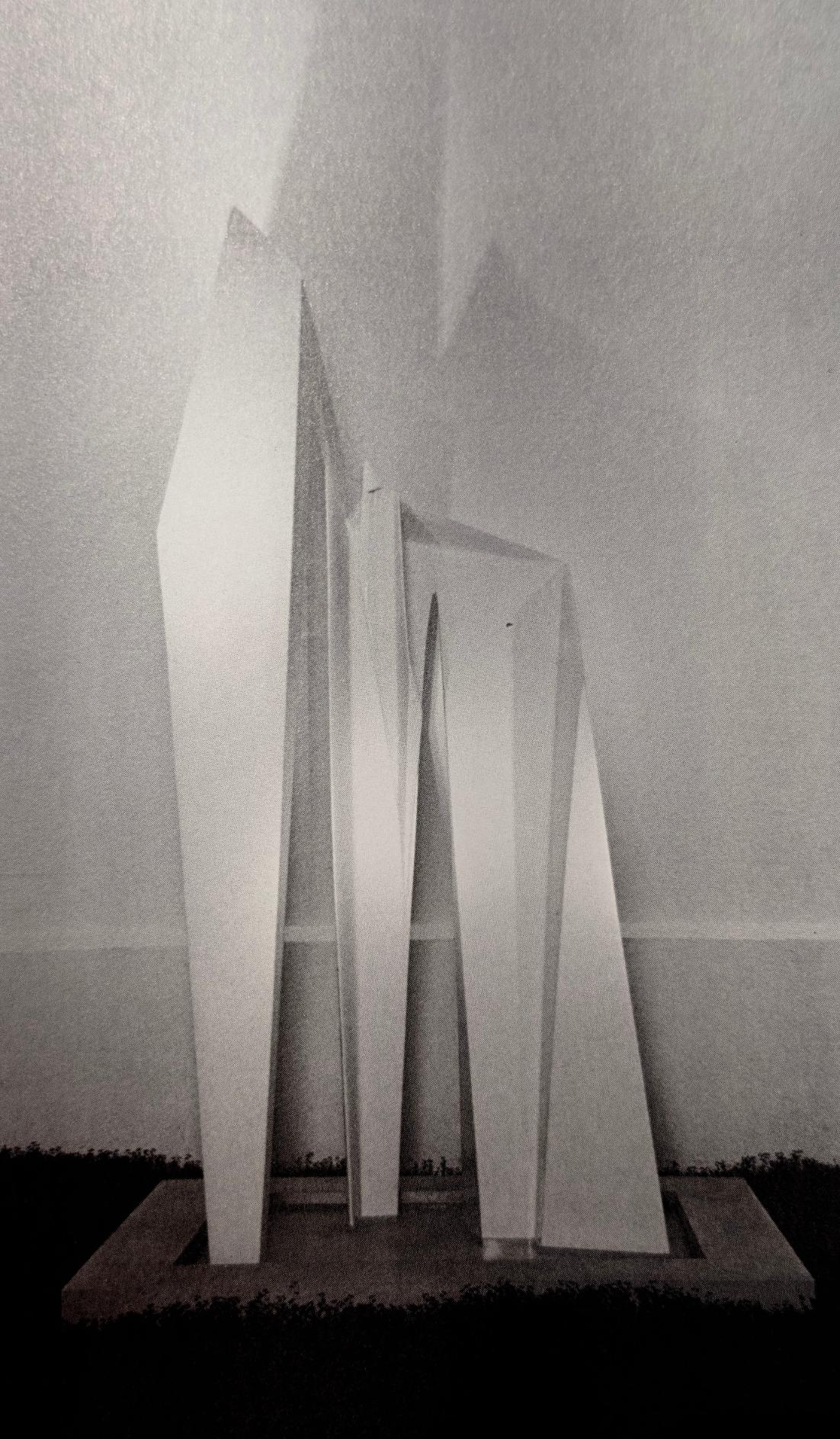

“On other evenings, I would catch La Tour d’Auvergne at his sketches, his foldings, his angelic folds… and later, seeing his hand upon the paper, in a manner that was also religious, for that is how both my friend and I choose to believe, I wondered whether he did not make better use of paper than I. Like the delighted schoolboy who turns his exercise sheet into a paper bird or a ship, and ultimately hands the teacher the finest assignment of all: immediately legible, flawlessly executed in a single gesture, and, beneath an apparent simplicity, filled with dreams that elevate us.”
Thus does Daniel Boulanger describe Yves de La Tour d’Auvergne and his work.
Part of this artist’s genius lies in his use of simple, commonplace materials produced in large quantities, such as metal mesh, wire grilles, paper, and packaging cardboard. He reveals their perfection and their formal and structural beauty, qualities that we generally overlook.
By cutting and folding these cardboards and wire meshes, originally intended for temporary use and a short lifespan, he reveals their strength and intrinsic permanence. He shows that the apparent order of corrugations and meshes conceals a hidden order no less rigorous, an equilibrium that renders the material imperishable, save for molecular wear or accidental destruction.
In this sense, La Tour d’Auvergne’s folded papers are no more ephemeral than the folios preserved in libraries or the prints held in museums. Their longevity depends entirely on the attention and care devoted to them.
Using cut and folded paper and cardboard, metal meshes, and regular geometric forms—hexagons, squares, rectangles, the artist composes bas-reliefs that captivate the imagination and lead it through the winding paths of the dreams described by Daniel Boulanger.
Yves de La Tour d’Auvergne makes as much use of the virtual image cast upon the wall as of the folding itself. In the foreground of his bas-reliefs, the graphic language of the folds prevails. In the background, a new graphic language emerges, written by the shadow cast by the first—a kind of luminous ash rising from the wall. Within the visual labyrinths he constructs, each volume becomes enveloped in shadow and light, bringing forth the third dimension, depth, and structure.
Graphic expression no longer owes anything to the brush or the pencil; it materializes through the structural lines of the fold itself. The fluidity of the light that results from it, together with the multiplication of shadows, gives rise to refined visual atmospheres that belong to a classical tradition characterized by restraint, sensitivity, and elegance.
The cast shadows of these veils, composed of folded or crumpled wire mesh combined with cut paper and cardboard, create shifting chiaroscuro effects upon the walls, whose shape, scale, and position vary according to sunlight and the hours of the day. They form what Yves de La Tour d’Auvergne describes as “echoes of silence.”
“With paper,” he adds, “the hand can express itself immediately; sensitivity instantly acquires substance and form.”


There exists an emotional and cultural relationship, but also a sensual one, between the artist and paper, which seduces through its softness and texture. Do we not speak of a paper’s “hand” when referring to its weight and quality? A paper with good “hand,” substance, and thickness is the paper of a fine book, a rare and carefully produced edition, a lithograph, or an engraving.
Yves de La Tour d’Auvergne is attentive to every quality of paper. He treats it with respect: he cuts it, folds it, colors it when necessary, producing rich tapestries, particularly when ink, line, and color are projected onto corrugated cardboard. Yet he neither glues nor tears it.
Its edges are always sharp and definitive.
He dislikes the imprecision of hand-torn edges and their uncertain fringes.
In his folded structures, there is nothing uncertain: chance has no place, and every edge is essential. When a flat surface becomes a relief under the pressure of the hand, it simultaneously discovers its structural lines and attains a new stability, an equilibrium from which emotion is by no means absent, but rather emerges precisely from the forms and forces at work. The artist compares these moments of balance to the emotional tension that lingers in a concert hall at the instant when the music stops and releases its energy in applause. “Without emotion,” he says, “there can be no accomplished work.”
These aerial structures, these enchanted clouds that inhabit the walls, find their counterpart and complement in La Tour d’Auvergne’s sculptures and furniture pieces, which he creates from marble powder, sheet steel, or lacquered aluminum. Employing a secret alchemy of his own, he achieves surfaces that are perfectly smooth, soft to the touch, sensual, responsive to contact, and receptive to the warmth of the hand; surfaces over which light sometimes glides and water flows silently. The purity and profile of these sculptures, derived from the geometry of folded paper, possess the elegance of graceful migratory birds, poised in superb balance amid the marshes.
Most of the works that populate the studio, sometimes cast in bronze, more often made from marble powder, or existing as models and folded-paper constructions, lend themselves naturally to monumental and urban realization. Such is the case with the fountain the artist designed for a public space in Paris, featuring a circular basin and a vertical jet of white marble.
The same formal truth can be found in his furniture. One encounters the same structural expressionism of expanded metal and folded sheet steel, an approach that would certainly not have been disowned by Jean Prouvé.
Neither too much nor too little: only what is necessary for strength, stability, and formal balance is retained.
The result is a new aesthetic, one that openly reveals the structural forces from which it arises.
To express and articulate his perception of the world and of art, Yves de La Tour d’Auvergne has chosen the path of rigor, a choice that by no means excludes poetry; quite the contrary. He unfolds a new calligraphic thread, a sensitive scenography, a language of singular presence, whose metaphors we are more than willing to follow.
One is captivated by the elegance, the vibrations, the subtle radiance, and the refinement of this body of work, which also possesses the rare quality of authenticity.

Read other focus


